English Greyhound Derby at Towcester: History, Format and Results
 Available in US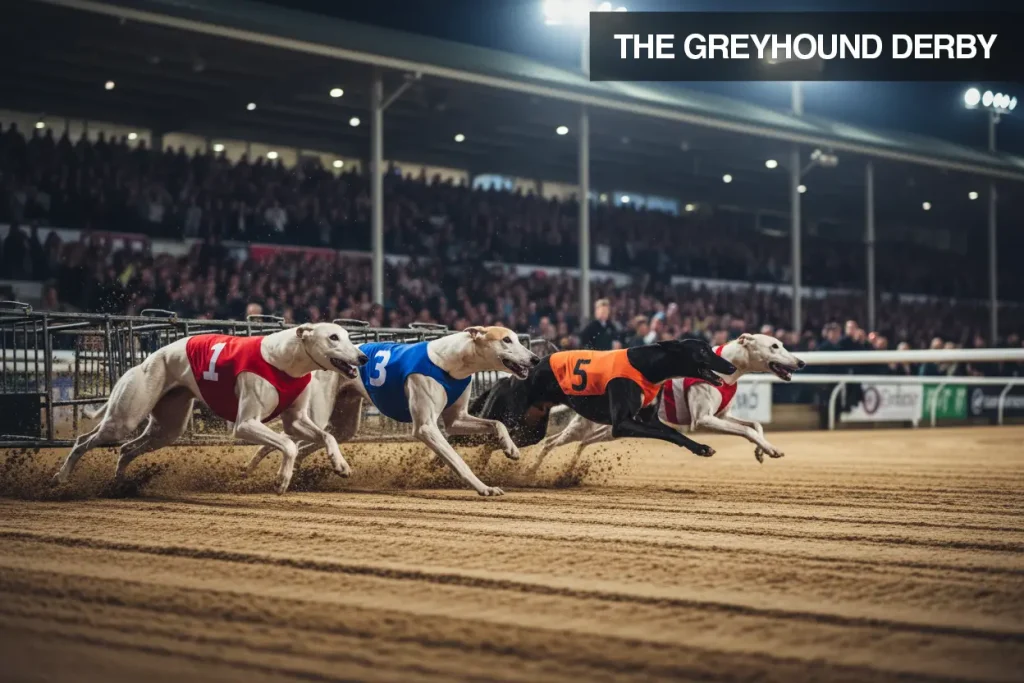
The Biggest Night in British Greyhound Racing Lives at Towcester
There is one night a year when greyhound racing in Britain commands mainstream attention, and that night belongs to the English Greyhound Derby final. It is the sport’s oldest classic, its richest prize, and its most prestigious title. Since 2021, the final has been a permanent fixture at Towcester — the event first moved here in 2017 after Wimbledon’s closure, spent two years at Nottingham (2019–2020) during the track’s administration period, and returned when racing resumed — and the track’s identity is now inseparable from the event that defines British greyhound racing.
The 2026 final delivered the kind of result that makes the Derby compelling even for people who never watch a graded Tuesday-night card. Droopys Plunge won at 10/1, with trainer Patrick Janssens and owners The-Three-Tall-Men Syndicate collecting the £175,000 first prize — the largest payout in the sport. It was not the favourite. It was not the form pick. It was a dog that peaked at exactly the right moment in a competition designed to find the best greyhound in the country over six rounds and several weeks of racing.
The towcester greyhound derby results tell a story that goes back almost a century. The Derby has been run since 1927, across some of the most famous venues in British sport. White City, Wimbledon, Wimbledon again, and now Towcester — the event has migrated as the sport’s geography has shifted. Each venue has left its mark on the competition, but the current era at Towcester has given the Derby a permanent home and a modern identity built on data, television coverage, and the kind of atmosphere that a purpose-built venue can deliver.
The roll of honour is in the Derby winners list.
Derby Origins: From White City 1927 to Towcester
The English Greyhound Derby was first run at White City Stadium in London on 15 October 1927. The venue was already famous — it had hosted the 1908 Olympic Games — and the inaugural Derby capitalised on that prestige. The winner was Entry Badge, and the crowd that watched the final was part of a wave of enthusiasm for greyhound racing that would sweep Britain through the late 1920s and 1930s, drawing millions of spectators annually to tracks across the country.
White City remained the Derby’s home until 1985, a span of nearly six decades during which the race established itself as the definitive test of greyhound quality in Britain. The names from that era read like a roll call of the sport’s mythology. Mick the Miller won in 1929 and 1930, becoming the first of only four greyhounds ever to win the Derby twice. The others — Patricias Hope, Rapid Ranger, and Westmead Hawk — achieved the feat decades apart, underlining how rare back-to-back victories are in a sport where a dog’s competitive window is measured in months rather than years.
When White City closed its doors for racing in the mid-1980s, the Derby moved to Wimbledon Stadium in south-west London. Wimbledon offered a different setting — more intimate, more atmospheric, and deeply embedded in the culture of London greyhound racing. The Derby thrived there for three decades, but the stadium’s closure in 2017 forced another relocation. Towcester, the newest purpose-built greyhound venue in Britain, inherited the event.
The transition to Towcester was not universally popular at first. London purists mourned the loss of a metropolitan setting. But the Derby at Towcester quickly established its own character. The purpose-built facilities, the wider bends, and the modern surface created a different kind of race — one that arguably tested a broader range of greyhound ability than Wimbledon’s tighter circuit had. Within a few years, the Derby at Towcester was no longer a transplant. It was the event’s natural home.
The historical weight of the Derby is difficult to overstate. The competition has been run continuously since 1927, surviving the Second World War, the decline of the sport in the late twentieth century, and the closure of iconic venues. Through all of that, it has remained the one race that every trainer, owner, and breeder in British greyhound racing measures their career against. Winning the Derby is the highest achievement available in the sport, and the roll of winners contains names that are spoken with a reverence usually reserved for human athletes.
Format: 180 Entries, Six Rounds, One Champion
The English Greyhound Derby is not a single race. It is a multi-week competition that begins with approximately 180 entries and runs through six rounds of elimination before producing a six-dog final. The format is designed to ensure that the winner has beaten the widest possible field over the most sustained period — not just won a single race on a single night.
Entries come from trainers across the United Kingdom and Ireland. The Derby is open to greyhounds that meet the entry criteria — typically age, registration, and qualifying-time standards — and the initial entry pool reflects the breadth of the sport’s talent base. From those 180-odd entrants, the first round sorts dogs into heats of six, with qualifiers advancing to the next stage.
Each round reduces the field. First round to second round, second to quarter-finals, quarter-finals to semi-finals, and semi-finals to the final. The exact structure varies slightly from year to year — occasionally a repechage round is included, giving eliminated dogs a second chance — but the principle is consistent: survive and advance. A dog that reaches the Derby final has won or placed in multiple rounds against strong competition, which means its form through the competition is a rich dataset in itself.
The distance for the Derby final at Towcester is 500 metres, slightly longer than the standard 480-metre middle-distance trip. The extra 20 metres adds a stamina element that distinguishes the Derby from regular four-bend racing. Over six rounds, the cumulative effect of racing a slightly longer trip in high-pressure fields takes a toll. Dogs that fade in the later rounds are often genuine talents that have simply been ground down by the competition’s demands. The winner is not just the fastest dog — it is the most durable.
Timing matters within the format. The rounds are typically spaced a week apart, which means a dog reaching the final has raced competitively at least five or six times over five to six weeks. That schedule tests recovery, consistency, and the trainer’s ability to keep the dog in peak condition. A brilliant performance in the first round means nothing if the dog cannot replicate it three weeks later. The Derby rewards sustained excellence, which is why the roll of winners includes so many greyhounds that are remembered as the best of their generation rather than one-night wonders.
For punters, the multi-round format generates an unusually complete form profile for each competitor. By the semi-final stage, every surviving dog has multiple runs over the Derby course at Towcester, which means the sectional data, trap preferences, and pace profiles are well documented. The final, paradoxically, is one of the most data-rich races on the calendar. The challenge is interpreting that data correctly — accounting for fatigue, draw, and the pressure of consecutive high-stakes races.
Recent Winners: 2026 and 2026 at Towcester
The 2026 English Greyhound Derby final was won by De Lahdedah, who equalled the track record over the 500-metre Derby course at Towcester with a time of 28.58 seconds. De Lahdedah became the third consecutive Irish-trained winner, a trend that highlighted the growing dominance of Irish kennels in the sport’s flagship event. The winning performance was emphatic — a front-running display that left the field trailing, delivered in a time that established a new benchmark for the Derby course.
The 2026 final flipped the script. Droopys Plunge arrived at 10/1, far from the head of the betting, and won decisively for trainer Patrick Janssens. The result confounded the form analysts who had focused on the more fancied runners, and it demonstrated a truth about the Derby that historical data supports: the competition’s multi-round format, combined with the pressure of the final itself, produces surprises more often than the market expects. Since the event moved to Towcester, upsets have been a recurring feature, with favourites struggling to convert strong early-round form into final-night victories.
The contrast between the two winners illustrates the range of profiles that can succeed. De Lahdedah was a course-and-distance specialist who controlled races from the front. Droopys Plunge was a more tactical runner who improved through the competition and peaked on the night that mattered most. Both approaches can win a Derby. The common thread is that both dogs were trained to perfection for the final — arriving in peak condition after a gruelling series of rounds.
Mark Bird, CEO of the GBGB, has placed the Derby within a broader narrative of the sport’s heritage. “2026 will be a year of celebration where we will remember the greats, including Mick The Miller, Ballyregan Bob, Scurlogue Champ and Westmead Hawk, while also demonstrating why our sport deserves its place in the 21st century,” he told the Racing Post. The Derby at Towcester is the annual event that does more than any other to make that case — a modern venue hosting a historic competition that connects the sport’s past to its present.
For punters analysing towcester greyhound derby results, the recent finals offer a practical lesson: look beyond the favourite. The Derby’s format is sufficiently demanding that pre-competition form does not always translate to final-night performance. Dogs that have had an easier route through the rounds — fewer hard races, kinder draws, less physical racing — sometimes arrive at the final fresher than more battle-hardened rivals. Freshness, in a race as competitive as the Derby final, can be the decisive edge.
What Makes Towcester the Derby Venue
Towcester’s claim to the Derby is not purely historical accident. The track offers practical advantages that suit the demands of the sport’s biggest event, and those advantages were built into the venue’s design from the beginning.
The track was constructed in 2014 at a cost of £1.5 million, with 60,000 tonnes of earth moved to create the greyhound circuit within the existing horse-racing venue. That investment produced a modern, purpose-built facility with wider bends than many older tracks, a sand surface selected for performance and safety, and infrastructure designed to accommodate large crowds and live television production. When Wimbledon closed in 2017, Towcester was the only track that combined the physical capacity, the surface quality, and the broadcast facilities needed to host the Derby to a modern standard.
The wider bends are particularly relevant for Derby racing. Over the 500-metre final distance, the dogs negotiate four turns at high speed in a field of six where every runner is an elite competitor. Tight bends produce more crowding, more interference, and more results determined by luck rather than ability. Towcester’s more generous geometry gives the dogs room to race, which tends to produce finals where the best dog wins rather than the luckiest. This is not a guarantee — Derby finals are chaotic by nature — but the track design tilts the odds towards merit.
The venue’s setting in Northamptonshire, surrounded by countryside, gives the Derby a different atmosphere from its London predecessors. White City and Wimbledon were urban events — embedded in the fabric of the city, accessible by public transport, drawing crowds from the surrounding boroughs. Towcester is a destination event. Attendees travel to it, which changes the dynamic: the crowd tends to be smaller but more committed, with a higher proportion of serious racing enthusiasts and a lower proportion of casual passers-by. Whether that is better or worse depends on your perspective, but it gives the Towcester Derby a distinct feel that regular attendees have come to value.
The track’s integration with the PGR schedule and Sky Sports Racing coverage adds a media dimension that the Derby has never had before. Finals are broadcast live to a national audience with full production values — multiple camera angles, expert analysis, pre-race features on the finalists. The presentation elevates the event and introduces it to viewers who might never attend a live meeting. For the sport’s profile, having the Derby showcased on a mainstream sports channel is worth more than any amount of trade-press coverage.
Records: Most Wins, Fastest Times, Longest Prices
The English Greyhound Derby’s record book stretches across nearly a century, and its entries capture the evolution of the sport from a pre-war spectacle to a modern, data-driven competition.
The training record belongs to Charlie Lister OBE, who trained seven Derby winners — a feat of sustained excellence that spanned decades and reflected Lister’s ability to prepare greyhounds for the specific demands of the competition. No other trainer has come close. The nearest challengers have two or three wins, which underscores how difficult it is to produce a Derby champion even once, let alone repeatedly. Lister’s record may stand forever, though the concentrated quality of modern Irish kennels is producing a new generation of trainers with ambitions to challenge it.
Only four greyhounds have won the Derby twice: Mick the Miller (1929, 1930), Patricias Hope (1972, 1973), Rapid Ranger (2000, 2001), and Westmead Hawk (2005, 2006). The double is the rarest achievement in British greyhound racing. It requires a dog to be the best in the country for two consecutive years — a window of sustained peak performance that is almost biologically impossible for a sport where a greyhound’s competitive career is measured in eighteen months to two years. Every dog that wins its first Derby is immediately assessed as a potential double winner, and almost every one fails the test.
The track record for the Derby course at Towcester was set by De Lahdedah in the 2026 final, establishing a benchmark that combines the speed of the dog with the specifics of Towcester’s surface and topography. Track records at greyhound venues are less stable than in human athletics because surface changes can render them incomparable. If the 300-tonne sand upgrade altered the surface profile enough to affect times, the pre-upgrade record exists in a different context from post-upgrade performances. Analysts should treat track records as indicative rather than absolute — they show what is possible on the course, not a fixed ceiling.
The longest-priced Derby winner in recent memory at Towcester illustrates the competition’s capacity for surprise. Outsiders have won the Derby at various points in its history, typically in years when the pre-competition favourite faltered in the later rounds and a less-fancied runner produced its best performance on the biggest night. The 2026 winner was sent off at double-figure odds, long enough to demonstrate that the Derby market consistently underestimates the variability introduced by six rounds of competition, six dogs in the final, and a 500-metre trip where any incident on any bend can change the outcome.
Prize-money records continue to climb. The £175,000 first prize in 2026 was the largest in the Derby’s history and one of the largest payouts in British greyhound racing of any era. That figure reflects both the Derby’s commercial importance and the investment that the sport’s stakeholders are making in the event’s prestige. For owners and trainers, the prize money transforms the Derby from a sporting ambition into a genuine financial target — a single final-night win can fund a kennel’s operation for a year.
Attending Derby Night: What to Expect
Derby final night at Towcester is the one evening a year when the track operates at full capacity, and the experience is materially different from a routine Tuesday meeting. If you are considering attending, it is worth knowing what to expect — both so you can plan your evening and so you can appreciate what the atmosphere adds to the racing.
Tickets for the Derby final typically go on sale weeks in advance and sell out or approach capacity. The pricing structure usually includes general admission and hospitality options, with the latter offering reserved seating, meals, and closer access to the trackside area. Hospitality packages are priced at a premium, but they represent the best way to experience the event if you want comfort and an unobstructed view of the action. General admission provides access to the public viewing areas and the betting ring, which is where the majority of the atmosphere is concentrated.
The card on Derby final night is not limited to the final itself. A full programme of supporting races runs alongside the main event, which means you are not paying for a single race — you are paying for an entire evening of high-quality racing. The supporting card often includes other finals and feature races, and the standard of the undercard is typically a step above a routine meeting. For anyone interested in form analysis, the supporting races provide data on dogs from a wide geographical catchment competing on a surface that is in peak condition for the occasion.
The atmosphere is distinctive. Derby night attracts a crowd that includes trainers, owners, breeders, journalists, and enthusiasts from across the country, alongside casual visitors drawn by the event’s reputation. The noise level is higher than a standard meeting, particularly as the final approaches. The parade of the six finalists before the race is a moment of genuine theatre — six greyhounds at the peak of their careers, each with a story that has been building through weeks of competition, walking the track in front of a crowd that knows the stakes.
Betting on Derby night is an experience in itself. On-course bookmakers set up alongside the standard tote windows, and the market for the final is often more liquid than for a routine race — more money flowing, more opinion in the prices, and more movement as information circulates. If you prefer to bet with a fixed-odds bookmaker online, the Derby final is one of the few greyhound races that draws enough market interest for the exchange prices to be tight and responsive. Either way, the market on the night is a richer data source than the market for a standard meeting.
Parking at Towcester on Derby night requires planning. The venue’s car park fills early, and the surrounding road network — the A5 corridor through Northamptonshire — handles the increased traffic but does not absorb it seamlessly. Arriving an hour before the first race is advisable if you want to park close and settle in before the card begins. The venue offers food and drink options ranging from basic trackside refreshments to the hospitality dining, and the quality has improved under Orchestrate’s management, consistent with the broader upgrade of the facilities.
The full picture is in our Towcester greyhound results guide.
