
Towcester 480m Results: Middle-Distance Racing Analysis
 Available in US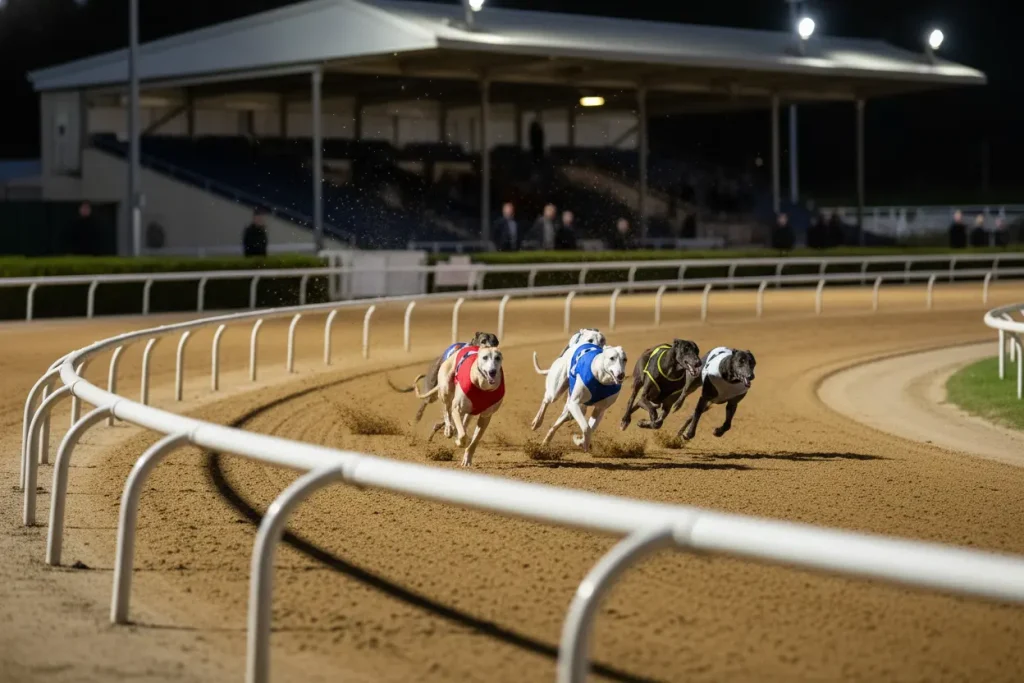
Towcester greyhound results 480m make up the smaller portion of the track’s programme — the majority of races are 270-metre sprints — but they are disproportionately important for serious form students. Four-bend races reveal more about a dog’s character, stamina and tactical intelligence than any sprint can, and the data they produce is richer in nuance. This page explains how 480-metre racing at Towcester differs from the sprint programme, what the sectional benchmarks tell you about running styles, and which trends are shaping recent results over this distance.
The sprint trip is covered in 270m results.
How 480m Racing Differs From Sprints
The fundamental difference is structural. A 270-metre race at Towcester covers two bends and two straights. A 480-metre race doubles that to four bends and includes a longer home straight. The additional distance is not simply more of the same — it changes the nature of the contest in ways that affect every aspect of analysis.
More Bends, More Variables
Each bend is a potential disruption point. Dogs can be crowded, checked, forced wide, or boxed in. At 270 metres there are two of these pinch points; at 480 there are four. The probability of trouble in running rises significantly, which means that the best-drawn, fastest dog does not win as predictably as it does in sprints. The 55.8% share of the programme held by 270-metre races reflects the track’s sprint emphasis, but the remaining 480-metre card generates outcomes that are harder to model and, for that reason, often richer in value.
Trap bias, which is pronounced at 270 metres, flattens at 480. Inside traps still have an edge into the first bend, but the extended race allows mid-pack runners to find room on subsequent turns. A dog drawn in trap four or five at 480 metres has a realistic path to the front if it has the pace and the racing brain to exploit gaps that simply do not exist in a two-bend dash.
Stamina as a Differentiator
Every greyhound tires during a race. The question at 480 metres is how much — and how visibly. A dog that decelerates by half a length over the final 50 metres of a 270-metre sprint barely notices; the race is over. The same deceleration over the final straight of a 480-metre race, which includes Towcester’s uphill gradient, can mean the difference between winning and finishing third. Stamina is not just physical fitness; it is the ability to sustain racing effort through four bends and up the home straight without losing competitive speed. Dogs that lack it can look impressive for three bends and then empty dramatically.
Tactical Complexity
Sprint races are largely decided by the first bend. Middle-distance races are decided by what happens everywhere else. A trainer sending a dog out over 480 metres has to consider whether it is a front-runner that benefits from leading early, a mid-pack stalker that picks up places through the bends, or a closer that needs the race to be run at pace so it can finish over tiring rivals. That tactical layer adds depth to form analysis and makes the 480-metre trip the more intellectually engaging puzzle for punters who enjoy working through data rather than simply backing the fastest breaker.
Pace Styles and Sectional Benchmarks
Sectional times are the key tool for understanding 480-metre racing at Towcester, and the benchmarks at this distance differ meaningfully from sprint norms. The first-bend split still indicates early speed, but the run-in split — the time from the final bend to the post — carries greater predictive weight because it measures how much a dog has left after covering four bends on a track with a six-metre elevation change.
Front-Runners
A front-runner at 480 metres posts a fast first-bend sectional and tries to dictate the pace from there. The risk is obvious: leading for four bends on an undulating track drains reserves. Front-runners that win at Towcester 480m tend to have strong mid-race splits as well as a fast break — they do not just lead, they sustain. If the mid-race split drops off, they are candidates to be caught in the home straight.
Stalkers and Closers
The stalker sits two or three lengths off the leader through the first two bends, then moves into contention on the third or fourth turn. This style suits dogs with good tactical speed — the ability to accelerate from behind without wasting energy on a prolonged run. The closer takes a more extreme approach, sitting last or near last and relying on a devastating final 80 metres. At Towcester, where the home straight slopes upward, closers need exceptional finishing stamina. A closer with a strong run-in sectional — measured consistently across multiple races, not just on its best night — is a genuine threat in any 480-metre race.
Surface Safety and Consistent Going
James Chalkley, Towcester’s Head of Racing, addressed the surface standards directly when discussing the track’s investment programme. Speaking to the Racing Post, he noted that the focus on surface quality was about delivering a track that is safe for greyhounds to run on from the first race to the last, throughout the entire year. For 480-metre racing, that consistency matters more than it does for sprints. A surface that deteriorates through a meeting — becoming looser or more uneven as successive races churn it up — disproportionately affects four-bend races because the dogs cover more ground. Consistent going from the opening 480-metre contest to the closing one means the sectional benchmarks you calculate from early races hold for later ones, which makes your data more reliable.
Key Dogs and Trends at 480m
Recent towcester greyhound results 480m show several notable patterns. The arrival of trainers with middle-distance pedigrees — particularly those from Oxford, where 480-metre racing was a regular feature — has improved the quality of four-bend fields. Cards that once featured thin 480-metre contests now offer fuller fields with tighter grading, which is good for the sport and useful for punters who rely on competitive races to generate meaningful data.
There has also been a tactical shift. With deeper fields, races are being run at a stronger pace through the early bends, which means front-runners face more pressure than they did when 480-metre cards at Towcester were shallower. The result is a slight uptick in the number of races where the winner comes from off the pace — closers and stalkers are winning more frequently than they did in 2026, and the correlation between a fast first-bend time and winning has weakened at this distance.
The planned introduction of an approximately 460-metre distance will add another dimension to middle-distance racing at the venue. If implemented, it would create a four-bend trip slightly shorter than 480, which could suit dogs that have the speed for 270 metres but the stamina for more than two bends. Until that distance is operational, the 480-metre trip remains the sole four-bend option in the graded programme, and its results carry the full weight of Towcester’s middle-distance data.
For punters, the practical advice is to treat 480-metre results as the track’s premium dataset for form analysis. The races are harder to predict than sprints, but the information they yield — about stamina, tactical speed, trainer intent and genuine class — repays the extra effort of studying them closely.
The wider context is set out in our Towcester greyhound results guide.
