
Towcester Greyhound Odds: How Prices Reflect Form and Market Moves
 Available in US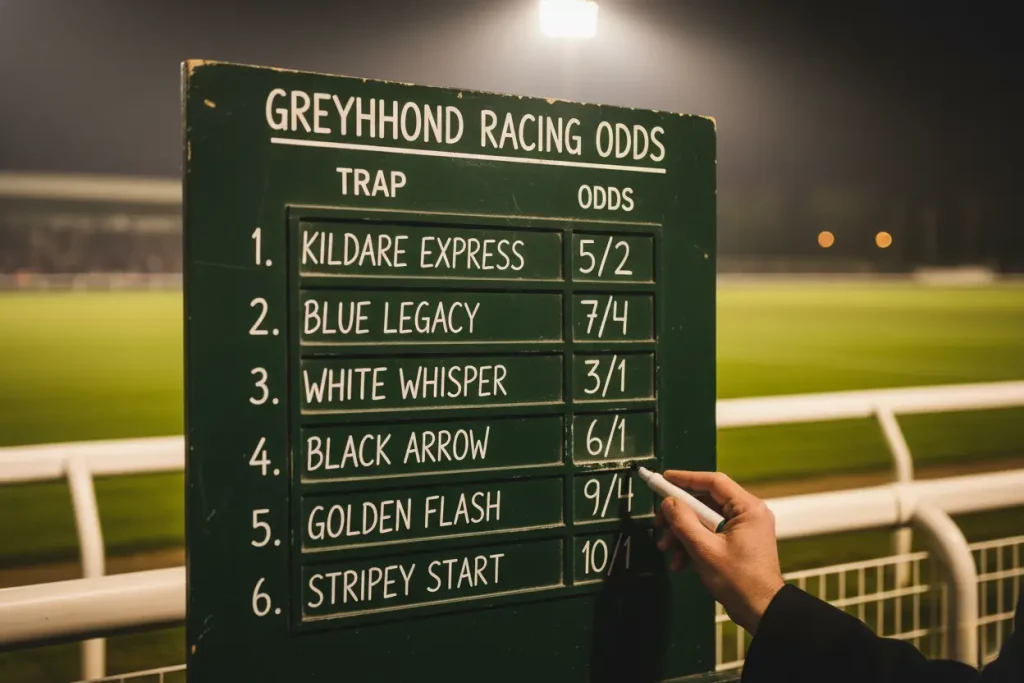
Pool bets settle differently: CSF and tricast.
How Greyhound Odds Are Compiled: Tissue to SP
Greyhound odds begin life as a tissue price — an internal estimate compiled by a bookmaker’s trader based on form analysis, grading data and market expectations. The tissue is not published; it is a starting framework that informs the first prices offered to the public. From there, the market takes over.
The Tissue
A tissue for a Towcester race is typically drawn up by a trader who studies the racecard: recent form, trap draw, grade, trainer, and any known preferences the dog has for distance or going. The result is a set of prices that sum to slightly more than 100% — the overround that builds in the bookmaker’s margin. A well-constructed tissue for a six-runner Towcester sprint might look like 2/1, 5/2, 3/1, 4/1, 8/1, 10/1, giving the favourite roughly a 33% implied chance and the outsider around 9%. The precision of this initial estimate depends on the quality of data available and the experience of the compiler.
From Tissue to Early Prices
Early prices are the first public odds, usually posted 10 to 15 minutes before the race. They are based on the tissue but adjusted for any known market trends — if a particular kennel’s dogs have been heavily backed all week, the trader may shorten that dog’s opening price pre-emptively. At Towcester, where the volume of racing means traders are pricing five meetings a week, patterns in how they adjust from tissue to opening price can be informative. A trader who consistently shortens a trainer’s runners is responding to persistent demand, which usually has a reason behind it.
SP: The Final Number
The starting price — SP — is the price returned to punters who do not take an early or fixed price. It is determined at the moment the race starts and reflects the balance of money that has been wagered on each runner. For Towcester, where betting-shop turnover on greyhound racing reached £794 million in the year ending March 2026, the SP is shaped primarily by shop and online activity rather than a large on-course market. This matters because the SP for a Towcester greyhound can be moved by relatively concentrated money — a few sizeable bets in betting shops or on an exchange can shift the price significantly in the final minutes.
The gap between the early price and the SP is where information lives. A dog that opens at 4/1 and goes off at 2/1 has attracted serious money. A dog that opens at 3/1 and drifts to 5/1 has been abandoned. Both moves tell you something about how informed money — or at least confident money — views the dog’s chances.
Reading Market Moves and What Drifters Signal
A market mover is a dog whose price shortens significantly between the early show and the SP. A drifter is one whose price lengthens. Neither label is definitive — steamers lose and drifters win — but across a large enough sample, market moves carry information that improves long-term analysis.
Why Prices Shorten
The most common reason for a shortening price is straightforward: punters who have studied the form believe the dog will win and are backing it. The money flows in, the bookmaker adjusts to balance liability, and the price drops. At Towcester, where the greyhound betting market sits within a broader UK wagering ecosystem worth approximately £1.46 billion annually, market moves on individual races can happen quickly because the pool of active bettors is smaller than in horse racing. A handful of informed punters backing a dog at multiple shops can be enough to trigger a significant price shift.
Less common but worth knowing: some price movements are driven by connections rather than analysts. A trainer placing a dog in a race it is expected to win may generate a wave of local money from people close to the kennel. This kind of insider confidence is harder to distinguish from analytical conviction, but it tends to show up as a sharp, late move rather than a gradual shortening throughout the afternoon.
Why Prices Drift
A drifting price indicates a lack of support. The bookmaker has offered a price and no one wants it, so the price lengthens to attract money and keep the book balanced. Drifters can be genuine non-contenders — dogs that the market has correctly assessed as outclassed — or they can be mispriced opportunities. A dog that drifts from 3/1 to 5/1 because the market has focused on a flashy favourite may represent value if your own form analysis disagrees with the consensus.
The discipline is distinguishing the two. A drifter with poor recent form, a bad trap draw and a trainer in a cold streak is probably drifting for good reason. A drifter with solid form that happens to be drawn against a heavily fancied runner may simply be overlooked. One is a dog to avoid; the other is a dog to consider.
Odds and Results Together: Spotting Value After the Race
Most punters think about odds before the race. Fewer think about them after it, but the post-race analysis of odds versus results is one of the most powerful tools available for refining your approach to Towcester greyhound odds over time.
The exercise is simple. After a meeting, review each race and compare the SP with the result. Did the favourite win? If not, what beat it — a market mover, a drifter, or a mid-price runner? Over a sample of 50 or 100 races, you can build a picture of how well the Towcester market prices form. If favourites win 30% of the time but are sent off at prices implying 40%, the market is systematically overestimating favourites — and there is value in opposing them. If outsiders win more often than their prices suggest, the market is underpricing longshots.
You can slice this data by distance, grade, day of week, or trainer. The patterns that emerge are specific to Towcester because the market is shaped by the punters who bet on Towcester, and their collective biases are local. A bias that exists in the Towcester betting market may not exist at Romford or Hove, because different punter pools price things differently.
The point is not to replace form analysis with odds analysis but to combine them. Form tells you which dog should win. Odds tell you what price the market is offering. Value — the gap between what you believe and what the market offers — is where long-term profit lives. Tracking Towcester greyhound odds against outcomes, race by race and week by week, is how you learn to spot that gap consistently rather than relying on guesswork.
The wider context is set out in our Towcester greyhound results guide.
