
Towcester vs Nottingham: A Greyhound Track Comparison
 Available in US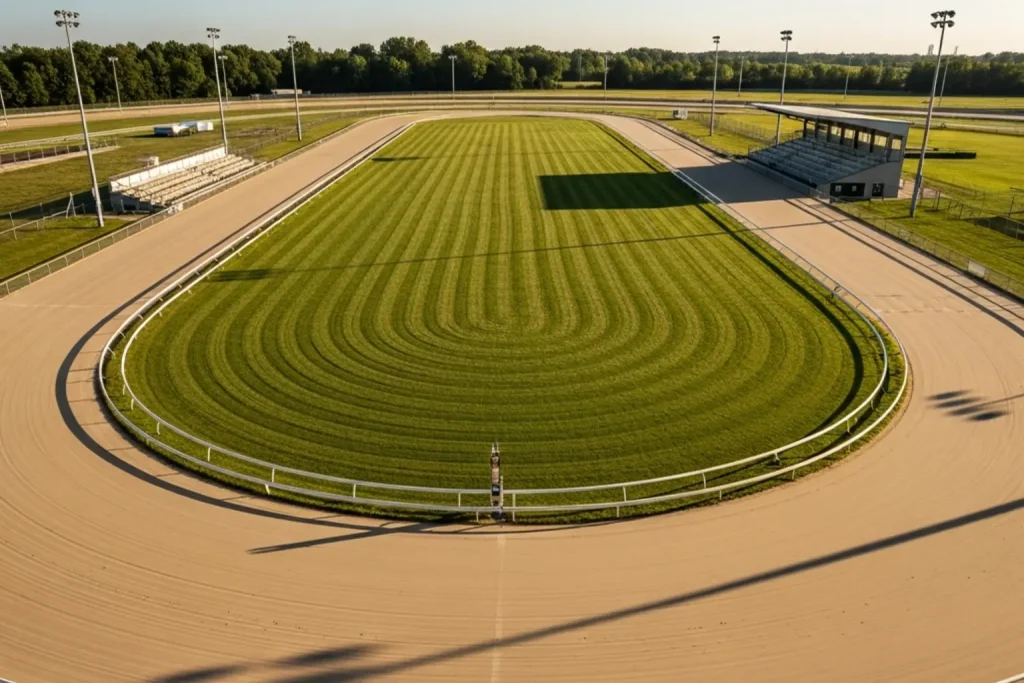
This towcester vs nottingham greyhound track comparison lays out the physical differences, explains how those differences affect times and form, and offers practical guidance for anyone who bets across both venues. The dogs may be the same breed, but the circuits they race on are as different as a hillside cross-country course and a flat athletics track.
Towcester’s own dimensions are in the track layout.
Dimensions, Surfaces and Layout Side by Side
Towcester: The Uphill Anomaly
Towcester was carved into the infield of an existing horse-racing venue in 2014. The construction involved moving 60,000 tonnes of earth to bring the greyhound surface level with the main straight of the horse course, creating a gradient that rises approximately six metres from the back straight to the home straight. That elevation change is Towcester’s defining physical characteristic. No other GBGB-licensed track has anything comparable. The circuit’s circumference sits around 420 metres, with wide bends designed to accommodate the undulating terrain — broader arcs than most British tracks, which give outside runners slightly more room than they would find at a tighter venue.
The surface is sand, refreshed in late 2026 with roughly 300 tonnes of new material as part of Orchestrate’s investment programme. The bends are gentle relative to the track’s size, but the gradient makes them more demanding than their radius alone would suggest: dogs running uphill through the home turn experience a different physical load than dogs rounding a flat bend of identical width.
Nottingham: Flat, Fast and Conventional
Nottingham is a flat track with a tighter circumference and sharper bends. It is one of the busiest venues in British greyhound racing, staging multiple meetings per week with a programme that covers sprint, middle-distance and stayer trips. The surface is sand, maintained to produce consistent going, and the absence of any meaningful gradient means that race times are dictated primarily by the dog’s speed and the sharpness of the bends rather than by topographical factors.
The tighter bends at Nottingham favour inside-drawn dogs more emphatically than Towcester’s wider turns. A greyhound in trap one at Nottingham has a pronounced rail advantage into the first bend, and that advantage persists through subsequent turns because there is less room for mid-pack runners to swing wide and gain ground. Sprint races in particular are heavily influenced by the trap draw at Nottingham.
Key Dimensional Differences
The most consequential differences between the two tracks are gradient, bend width and running-rail geometry. Towcester’s uphill finish tests stamina in a way that Nottingham’s flat straight does not. Towcester’s wider bends give outside runners a slightly better chance, while Nottingham’s tighter bends amplify the inside-trap bias. And Towcester’s larger circumference means that 480-metre races feel more expansive, with longer straights and fewer congestion points at the turns.
These are not subtle distinctions. A front-runner that dominates at Nottingham by seizing the rail and holding on through tight bends may struggle at Towcester, where the wider turns reduce the rail advantage and the uphill finish demands reserves that a flat track never tests. Conversely, a strong-finishing dog that gets caught in traffic on Nottingham’s tight bends may thrive at Towcester, where the wider geometry gives it room to run.
How Track Differences Affect Times and Form Transfer
When a greyhound moves between Towcester and Nottingham — or when you are assessing a dog’s Nottingham form to predict how it will run at Towcester — raw times are the first thing to discard. A dog that clocks 29.5 seconds over 480 metres at Nottingham is not directly comparable to one that records 30.0 at Towcester, because the tracks impose different physical demands. The Towcester time is slower but the race was harder, and treating the numbers as equivalent will lead you astray.
What Transfers and What Does Not
Sectional profiles transfer better than finishing times. A dog with a fast first-bend split at Nottingham will likely show early pace at Towcester too — the break from the traps and the run to the first turn are biomechanically similar regardless of venue. What changes is the run-in. A dog with a moderate run-in split at Nottingham — adequate on a flat track — may fade at Towcester when the uphill finish asks a question that Nottingham never did. Checking the run-in data before assuming a Nottingham form line will reproduce at Towcester is a basic but often overlooked step.
Trap-bias assumptions also need adjusting. A dog that wins consistently from trap one at Nottingham benefits from a pronounced inside advantage that is less extreme at Towcester. If that dog is drawn wide at Towcester, its Nottingham form — built on favourable draws at a tighter track — is less predictive. The reverse applies too: a dog that performs well from wide draws at Towcester may find Nottingham’s tighter bends more punishing.
The Dunstall Park Reference Point
Dunstall Park, which opened in September 2026 as the first new British greyhound stadium since Towcester in 2014, offers a useful third reference point for cross-track analysis. As a modern build, it shares some design characteristics with Towcester — wider bends, a newer surface — while sitting closer to Nottingham geographically and in the PGR schedule. Dogs that run at all three venues provide the most complete dataset for understanding how form transfers between different track geometries. As the British calendar continues to evolve, the ability to read form across tracks rather than in isolation will only become more valuable.
Practical Tips for Cross-Track Punting
First, always prioritise course form. A dog with three runs at Towcester gives you Towcester-specific data — gradient-tested, surface-tested, bend-width-tested. Three runs at Nottingham tell you about the dog’s ability, but not about how it handles Towcester’s unique conditions. When Towcester form is available, use it. When it is not, use Nottingham form as a starting point and apply the adjustments described above.
Second, respect the gradient. If you are comparing two dogs of similar ability — one with Towcester experience, one transferring from Nottingham — give the edge to the dog that has already proven it can handle the uphill finish. The gradient is not a marginal factor; it is a material one. Dogs that have run at Towcester and maintained strong run-in sectionals have passed a stamina test that flat-track form simply cannot replicate.
Third, adjust your expectations for times. Do not expect a towcester vs nottingham greyhound track comparison to produce matching numbers. Towcester times will be slower, and that is normal. The useful comparison is relative performance within each track’s context: a dog that posts top-three sectional splits for its grade at Nottingham is likely to be competitive at its equivalent grade at Towcester, even if the raw times look different.
Finally, watch for dogs that shuttle between both venues. Trainers in the Midlands corridor sometimes split their entries between Towcester and Nottingham, and a dog that has recent form at both tracks gives you the richest dataset of all — a direct, controlled comparison of how the same animal performs on two different surfaces and layouts. Those dogs are the most reliable guide to understanding the form-transfer relationship between these two tracks.
The wider context is set out in our Towcester greyhound results guide.
