Orchestrate and the New Era at Towcester Racecourse
 Available in US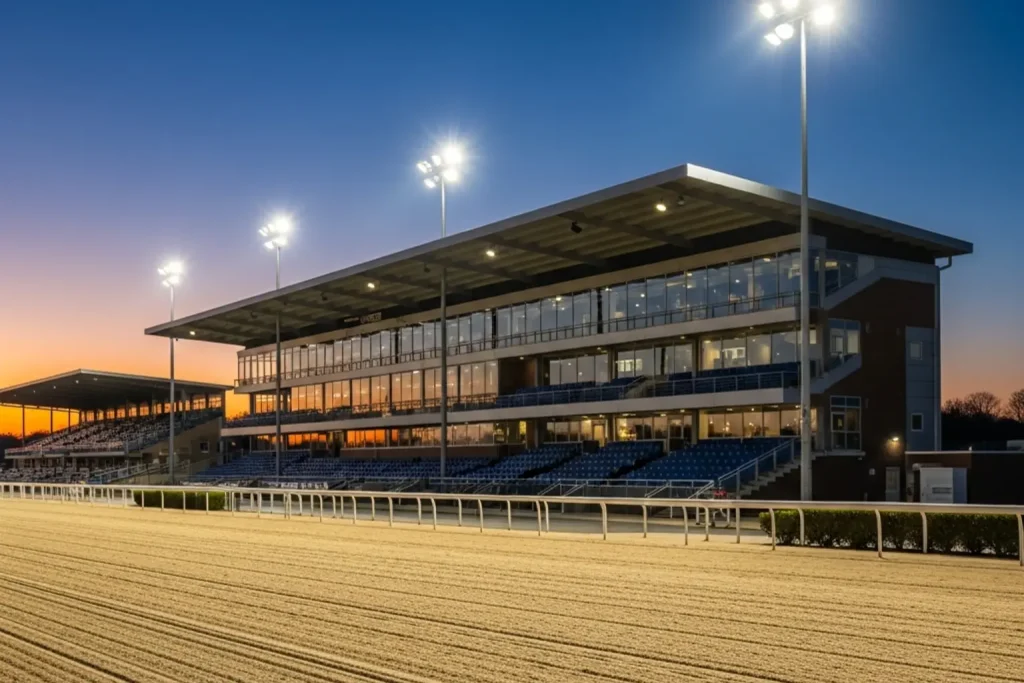
Within weeks of the Orchestrate towcester racecourse transition, the new management had resurfaced the track, recruited trainers from closing venues, negotiated a broadcast deal with Sky Sports Racing, and expanded the fixture list to five meetings a week. The pace of change was unusual in an industry accustomed to incremental progress, and it signalled a level of ambition that Towcester had not seen since its opening in 2014.
The kennels that followed are in top trainers.
Who Is Orchestrate and What They Inherited
Orchestrate is not a household name in British racing. The company, owned by Mike Davis, operates in the events and venue-management space and had not previously held a GBGB-licensed track. The decision to take on Towcester was as much about the opportunity as the challenge: the venue had a modern greyhound track, a historic horse-racing course, and a catchment area stretching across the Midlands — but years of underinvestment under successive promoters had left the facilities tired and the programme thinner than the infrastructure deserved.
The Leadership Appointment
Orchestrate’s most visible early move was the appointment of Richard Thomas as CEO. Thomas brought more than 20 years of experience from Chester Race Company, where he had developed the hospitality brand Horseradish and helped grow Chester into one of the most commercially successful racecourses in Britain. His background was in horse racing rather than greyhounds, but the skill set — venue management, commercial development, hospitality — translated directly to what Towcester needed.
Thomas’s appointment sent a signal that Orchestrate intended to run Towcester as a professional racecourse business, not just a greyhound track. The distinction matters: it meant thinking about the venue as a destination with multiple revenue streams — racing, hospitality, events, broadcasting — rather than as a facility that existed solely to host BAGS meetings.
What They Inherited
The Towcester that Orchestrate took over in November 2026 had a functional greyhound track but a depleted kennel roster, a limited fixture list of three to four meetings per week, and no premium broadcast deal. The horse-racing course had been dormant for years, with no fixtures and minimal maintenance on the equine facilities. The physical infrastructure — grandstand, car parks, trackside areas — was adequate but lacked the investment that a competitive modern venue requires.
The greyhound programme under Henlow Racing had maintained a basic level of quality, but the venue had never fully capitalised on its unusual physical characteristics — the elevation, the wide bends, the dual-purpose site — to differentiate itself from other tracks on the circuit. That gap between potential and reality was what Orchestrate set out to close.
Investments: Sand, Staff, Schedule and Media
The investment programme moved quickly across four fronts: surface, personnel, schedule and media. Each was connected to the others, and the speed at which all four were addressed reflected a coordinated strategy rather than piecemeal improvements.
Surface
The most tangible early change was the addition of approximately 300 tonnes of new sand to the running surface, accompanied by revised maintenance regimes and the recruitment of experienced groundstaff. The surface overhaul was not cosmetic — it addressed years of gradual deterioration and aimed to deliver consistent, safe going from the first race of a meeting to the last.
Personnel
Orchestrate moved to fill the kennel roster by attracting trainers from venues that had recently lost their racing calendars. Darryl Porter, Peter Swadden and Kevin Crocker arrived from Swindon; Dave Jeans, Tony Welch and Nick Deas came from Oxford. The recruitment was supported by what Orchestrate described as an industry-leading prize-money and trainer-payment structure — a financial package designed to make Towcester an attractive base for professional kennels.
The effect on field quality was visible within weeks. Cards that had previously featured thin fields in the lower grades were now filled with six-runner races across the full grading spectrum. The deeper kennel pool also improved the standard of upper-grade racing, because trainers who had been competing at other tracks brought dogs with open-race experience and graded form that Towcester’s previous roster could not match. The investment in people was arguably as significant as the investment in sand — a track is only as good as the dogs that run on it, and the dogs only come if the trainers have a reason to be there.
Schedule
The fixture list expanded from three or four meetings a week to five, aligning Towcester with the Premier Greyhound Racing schedule operated by Arena Racing Company. The additional meetings meant more racing, more data, and more betting product for the bookmakers whose funding underpins the BAGS model.
Media
From 25 November 2026, Towcester’s races were broadcast on Sky Sports Racing and streamed via attheraces.com — a deal that brought the track’s coverage in line with the highest-profile venues on the PGR circuit. The broadcast partnership was negotiated as part of the PGR entry and gave Towcester’s racing a national audience it had previously lacked. For punters and viewers outside the Midlands, the deal meant that Towcester results moved from a data-only experience — checking numbers on a website — to a watchable product with live commentary, camera coverage and real-time analysis.
How the Four Fronts Connect
The investments are interdependent. A better surface attracts better trainers. Better trainers enter stronger dogs. Stronger fields produce better racing. Better racing justifies premium broadcast slots. And premium broadcast deals generate the revenue to sustain the whole cycle. Orchestrate’s approach was to invest in all four simultaneously rather than sequentially, which compressed the transformation timeline but required a level of upfront commitment that previous operators had not been willing or able to make. The early results — fuller fields, a busier schedule, national TV coverage — suggest the strategy is working, though the real test will be whether it sustains over the full term of the 10-year lease.
What Comes Next: Horse Racing Return and Long-Term Vision
The greyhound programme is the foundation of Orchestrate towcester racecourse operations, but it is not the ceiling. The most ambitious element of the long-term plan is the return of horse racing to the venue — a move that would make Towcester one of a very small number of British courses staging both codes on a regular basis.
Towcester Racecourse was originally a National Hunt course before it hosted greyhounds, and the equine facilities — while dormant — still exist on site. Orchestrate has announced plans to bring horses back through schooling days and a premium point-to-point fixture, positioning the venue as a dual-purpose destination that can host both codes. The concept has a precedent: Dunstall Park in Wolverhampton staged the first combined horse-and-greyhound fixture in British racing history in March 2026, demonstrating that dual-code events are commercially viable.
Beyond the horse-racing plan, the trajectory is towards expanding the events calendar and improving the visitor experience. Richard Thomas’s background in hospitality suggests that corporate events, group bookings and premium race nights will feature increasingly prominently in the business model. The 10-year lease gives Orchestrate a long enough horizon to invest in infrastructure improvements that would not make financial sense on a shorter tenancy.
For the greyhound programme specifically, the introduction of an approximately 460-metre distance remains on the agenda, which would give Towcester a third primary trip and broaden the range of dogs that can be campaigned effectively at the venue. Whether these plans materialise in full or are adjusted along the way, the direction is clear: Orchestrate inherited a venue with unrealised potential and is investing to close the gap between what Towcester is and what it could be.
The wider context is set out in our Towcester greyhound results guide.
