How Weather Affects Towcester Greyhound Race Times and Results
 Available in US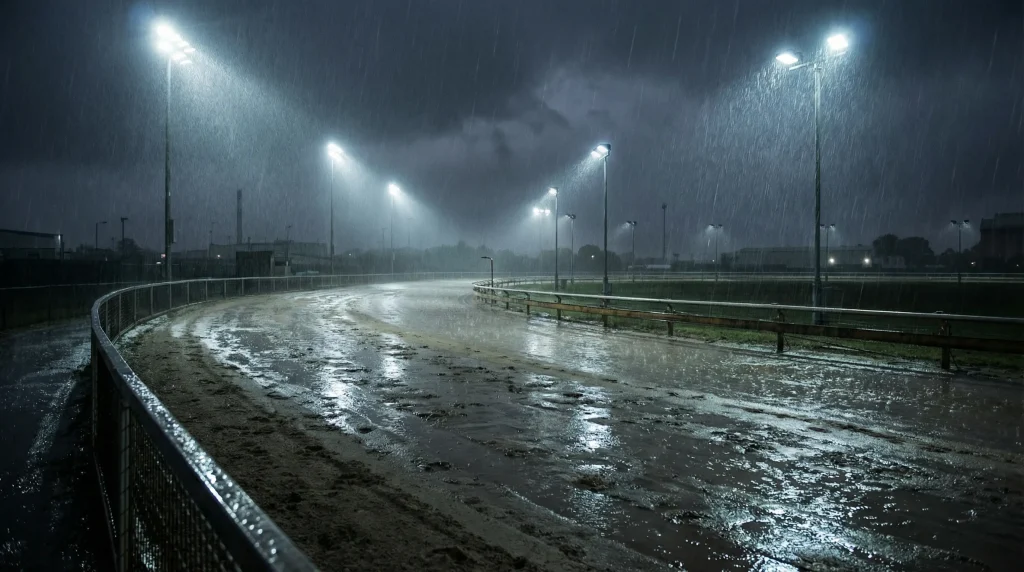
At Towcester, the interaction between weather and track is amplified by two features that most GBGB venues do not share: a sand surface that was comprehensively overhauled in late 2026, and a six-metre elevation change that alters how water drains, how frost forms, and how heat dries the running line. This page examines how rain, frost and heat change the surface, how to read weather into your result analysis, and what the track team does between races to manage conditions.
How the surface behaves is in the track layout.
Rain, Frost and Heat: How Each Condition Changes the Surface
Rain
Rain is the most common weather variable at Towcester and the one with the most direct impact on race times. When water saturates the sand, the surface becomes heavier and slower. Dogs expend more energy with each stride, and the effect compounds over the length of a race. At 270 metres, a wet surface might add two or three tenths of a second to typical winning times. At 480 metres, the impact is larger because the dogs cover more ground and the uphill finish becomes more demanding on a surface that is already sapping their reserves.
The 300 tonnes of new sand laid on the Towcester track in late 2026 were selected in part for their drainage properties. James Chalkley, the Head of Racing, described the surface overhaul as an exercise in going back to basics, with the aim of delivering a track that is safe for greyhounds from the first race to the last, all year round. Improved drainage means the surface recovers from rain faster than it did under the old sand, but even optimised drainage cannot eliminate the effect entirely. Persistent rain during a meeting will slow the surface progressively, and late races on a wet card may ride heavier than early ones.
Frost
Frost is a binary problem rather than a gradual one. A light frost that melts before racing begins has minimal impact on times. A hard frost that penetrates the surface can make the sand dangerously firm and uneven, at which point the track team may decide the surface is unsafe and the meeting is abandoned or delayed. Towcester’s hillside position means that cold air settles unevenly across the site — lower-lying sections of the track may frost harder than elevated sections, creating inconsistency across the circuit that is difficult to manage.
In winter, the risk of frost-related abandonment is a practical consideration for anyone planning to attend or bet on evening meetings. Checking the forecast is not just analytical good practice — it is insurance against wasted time and money.
Heat and Dry Conditions
Prolonged dry weather firms the surface, producing faster times and favouring dogs with sharp early pace. A firm track at Towcester rewards the front-runner who breaks cleanly and holds the rail, because the surface offers less resistance and the dog can maintain speed with less effort. Conversely, a dog that relies on strong finishing stamina may find its advantage reduced on a fast surface, because rivals are not tiring as quickly through the bends and the home straight.
Extreme heat can also dry the sand to a point where it becomes loose on the top layer, which introduces a different kind of inconsistency. The Towcester track team manages this through watering, but the balance between too dry and too wet is a fine one, and conditions can shift within a single meeting as temperatures change through an evening session.
Reading Weather Into Your Towcester Result Analysis
The most common analytical error is comparing times across different conditions as if they were recorded on the same surface. A dog that clocks 16.0 seconds at 270 metres on a dry, firm evening has run a different race from one that clocks 16.3 on a wet night. The second time is slower, but the effort may have been greater, and the dog may actually be the stronger runner when the surface levels the playing field.
Towcester’s six-metre elevation change amplifies weather effects in a way that flat tracks do not. Rain water runs downhill, which means the lower sections of the track may ride heavier than the higher sections after a shower. The home straight, which runs uphill, drains more quickly than the back straight, which sits at the bottom of the gradient. This creates a within-race variation in going that is unique to Towcester: a dog may experience softer ground on the back straight and firmer ground on the home straight within the same lap.
For practical analysis, the best approach is to note the conditions for every result you record and to compare like with like. Group your Towcester data by going conditions — dry, good, soft, heavy, or whatever shorthand you prefer — and calculate separate benchmarks for each. A dog’s best time on heavy going is a more useful predictor of its next run on heavy going than its best time on a fast surface. The weather effect towcester greyhound race times is not a complication to be ignored; it is a variable that, once understood, makes your analysis sharper.
Maintenance Response: What the Track Team Does Between Races
The Towcester track team works between every race on the card to maintain the surface. After each contest, the sand is harrowed to smooth out the footprints and redistribute the surface material. On wet evenings, the team may adjust the harrowing depth or frequency to manage the moisture content. On dry evenings, the track may be watered between races to prevent the surface becoming too loose.
Under Orchestrate’s management, the recruitment of experienced groundstaff — including specialists brought in specifically for their knowledge of sand-track preparation — has improved the consistency of the surface from first race to last. The goal is to minimise within-meeting variation so that the conditions a dog experiences in race one are as close as possible to the conditions in race twelve. Perfect consistency is not achievable in an outdoor environment, but the gap between first-race and last-race conditions has narrowed since the surface overhaul, and that improved consistency makes the resulting data more reliable for form analysis.
For punters, the practical takeaway is that the Towcester surface is actively managed, not passively endured. The track team’s work means that weather effects, while real, are moderated rather than amplified as a meeting progresses. That moderation is most effective on evenings with light rain or moderate temperatures; heavy downpours or extreme cold can overwhelm even the best maintenance regime, and those are the meetings where conditions should carry the most weight in your analysis.
The wider context is set out in our Towcester greyhound results guide.
