
Towcester Saturday Night Greyhound Racing: Card Structure and Atmosphere
 Available in US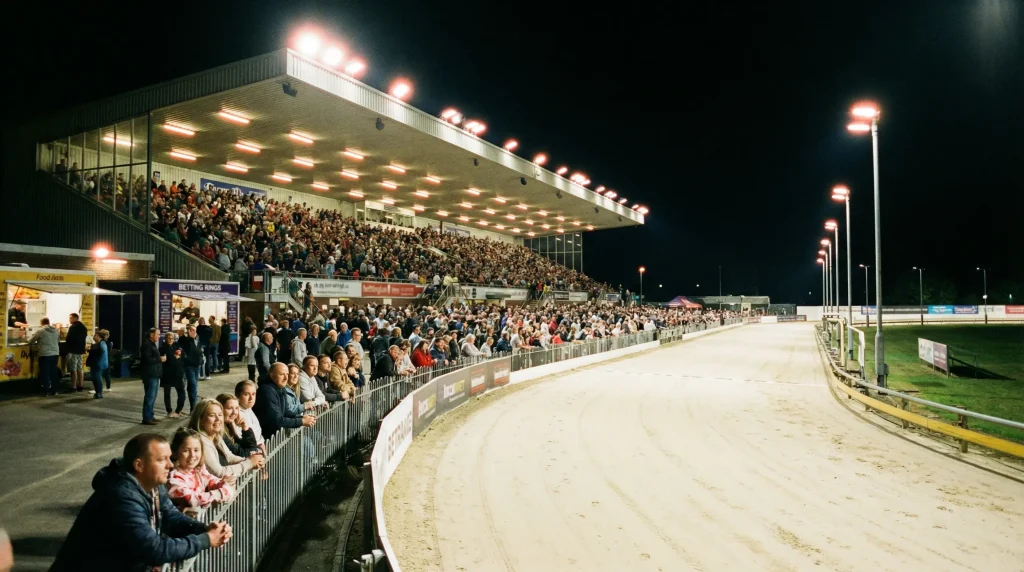
This page breaks down what a Saturday card at Towcester looks like, what the atmosphere offers that a Tuesday afternoon BAGS meeting does not, and how the competitive dynamics of Saturday racing affect the data you use for form analysis.
The rest of the week is in the fixture schedule.
Typical Saturday Card: Races, Distances and Grades
A standard Saturday evening card at Towcester features between 10 and 12 races, consistent with the venue’s midweek BAGS programme in terms of volume but different in composition. The distance mix follows the track’s overall pattern — roughly 55.8% of graded races at Towcester are run over 270 metres, with 480-metre races making up the bulk of the remainder — but Saturday cards tend to include a slightly higher proportion of middle-distance and feature races than a typical daytime meeting.
Grade Distribution
The grading on a Saturday card generally skews higher than on a midweek afternoon. Trainers hold back their stronger dogs for Saturday evenings, when the prize money is better, the broadcast profile is higher, and the fields are more competitive. The result is that Saturday cards frequently feature races from A1 through A4 that might not appear on a quieter Tuesday schedule. Lower-grade races still fill the card — you will see A6, A7 and A8 events on a Saturday — but the top end of the programme is noticeably stronger.
Feature races and opens are more commonly scheduled on Saturdays. These are the events that attract entries from beyond the resident kennel pool, with trainers from other tracks sometimes travelling to Towcester for a Saturday feature that carries prize money above the BAGS standard. The presence of visiting dogs adds a layer of uncertainty that regular midweek cards lack, because visiting runners do not carry Towcester-specific form and their performance on the gradient is an unknown.
First-Race Time and Spacing
Saturday evening meetings typically start later than weekday daytime fixtures — usually around 6.00 or 6.30 p.m., with the final race finishing before 10 p.m. The later start is designed to catch the leisure audience: people finishing their day, arriving at the track for an evening out, or settling in front of the television after dinner. Race spacing remains at the standard 12 to 15 minutes, giving punters time between races to study the next card, assess the market, and watch replays of the previous contest.
The Saturday Distance Mix
While sprints still dominate numerically, Saturday cards at Towcester tend to include more 480-metre races than a typical midweek afternoon. The reasoning is partly commercial — four-bend races are more dramatic for the television audience, with more bends creating more narrative turns in each contest — and partly sporting. Trainers with strong middle-distance dogs often target Saturdays for their best entries, knowing that the grading will be deeper and the competition genuine. For form students, this means Saturday cards produce a richer 480-metre dataset per meeting than any other day of the week, making them particularly valuable for anyone building a picture of middle-distance trends at the track.
Saturday Night Atmosphere and What to Expect
The atmosphere at a Saturday meeting is measurably different from a daytime BAGS fixture. The crowd is larger, noisier and more varied. Midweek afternoons at Towcester attract a core of regulars — serious punters, retired enthusiasts, trainers watching their own dogs — and the trackside mood is focused and quiet. Saturday evenings bring in groups, couples, families and first-timers alongside the regulars, and the energy shifts accordingly.
The racecourse’s hospitality operation runs at a higher level on Saturdays. The bar is busier, the catering is more extensive, and the venue has the feel of an event rather than a routine meeting. Under Orchestrate’s management, the Saturday experience has been deliberately enhanced. James Chalkley, Towcester’s Head of Racing, has framed the broader investment programme around giving participants and spectators the best possible experience on and off the track — and Saturday night is where that ambition is most visible. The improved surface, the deeper fields, the Sky Sports broadcast and the hospitality upgrades all converge on the Saturday card to produce the week’s flagship meeting.
For visitors experiencing Towcester for the first time, Saturday is the natural choice. The venue is at its liveliest, the racing is at its most competitive, and the combination of live action, food, drink and the rural Northamptonshire setting makes for a night out that feels distinct from a typical sporting-venue experience. The grandstand overlooks the bends and the home straight, and on a clear evening the views across the racecourse grounds add a dimension that no urban stadium can match.
How Saturday Results Differ: Fields, Odds and Bias
From an analytical perspective, Saturday results at Towcester should be treated as a distinct dataset rather than lumped in with midweek cards. Three factors drive the difference.
First, field quality. Stronger dogs entered on Saturday produce tighter finishing margins, which means that the trap draw and race tactics have more influence on the outcome than they do in lower-grade midweek races where one dog may simply be faster than the rest. Trap bias at 270 metres remains relevant on Saturdays, but it is tempered by the higher class of the runners — elite sprinters can overcome a wide draw more effectively than A7 dogs can.
Second, market efficiency. Saturday markets are more heavily traded than midweek ones. More punters are watching, more money flows through the betting ring, and starting prices tend to be sharper — meaning the favourite is less likely to be overpriced. Finding value on a Saturday card requires more precise analysis than on a Tuesday afternoon, where the market is thinner and mispricings are more common.
Third, surface condition. Saturday is typically the fifth meeting of the week, which means the track has been raced on for four previous sessions. Surface wear accumulates through the week, and despite the track team’s maintenance regime, the going on Saturday may ride slightly differently than it did on Monday. Checking how times have progressed through the week — whether they have slowed as the surface loosened, or held steady — gives you a condition context that most punters overlook when studying towcester greyhound results saturday.
The wider context is set out in our Towcester greyhound results guide.
