Dunstall Park Greyhound Stadium: The Newest Track in British Racing
 Available in US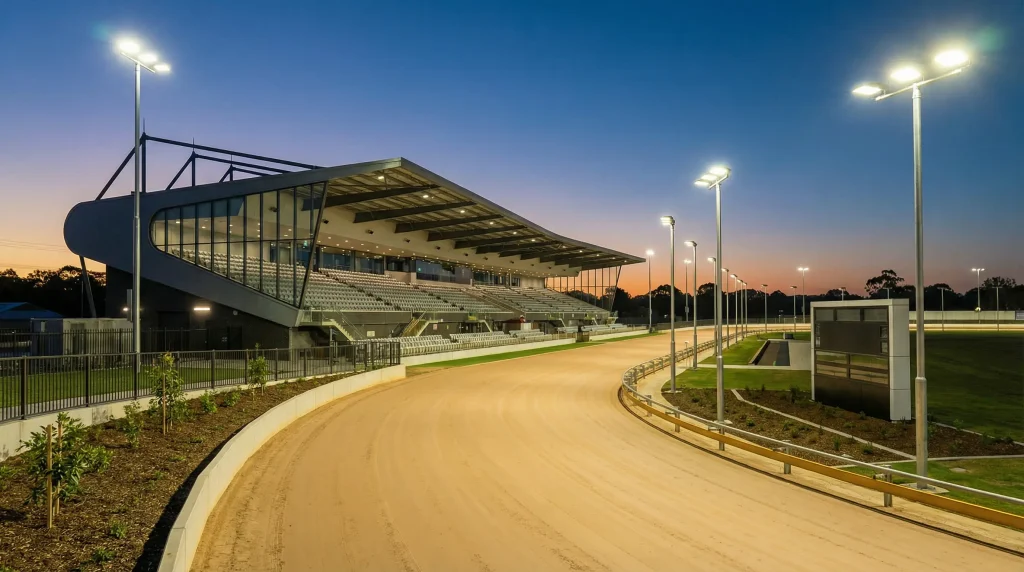
The arrival of a new Dunstall Park greyhound stadium in a market that has spent decades contracting is noteworthy on its own. But the venue’s significance goes beyond the fact of its existence. Dunstall Park represents a model — the integrated horse-and-greyhound venue — that Towcester is also pursuing, and the early operational data from Wolverhampton is being watched closely by anyone interested in the future shape of British racing.
Every other venue is mapped in all 18 GBGB stadiums.
Facilities, Track Specs and the Dual-Venue Concept
Dunstall Park’s greyhound track was built inside the all-weather horse-racing circuit at Wolverhampton Racecourse. The venue already had grandstands, hospitality suites, car parking and broadcast infrastructure — all of which the greyhound operation inherited without needing to build from scratch. That shared-infrastructure model is one reason the project was commercially viable: the marginal cost of adding a greyhound track to an existing racing venue is a fraction of the cost of building a standalone stadium.
Track Configuration
The greyhound circuit is a modern sand-track build on flat ground. Unlike Towcester, there is no meaningful gradient — the running surface is level throughout, which produces a different racing dynamic and a different set of form-analysis considerations. The bends are designed to contemporary safety standards, and the distances available include sprint and middle-distance trips consistent with the GBGB programme requirements for a PGR-affiliated venue.
The facilities include a modern kennel block, veterinary station, and race-night operations centre, all built to GBGB licensing standards. The integration with the horse-course grandstand means that spectators watching greyhound racing have access to the same hospitality facilities that serve Wolverhampton’s all-weather horse meetings — a standard of venue that most standalone greyhound stadiums cannot match.
The Dual-Fixture Milestone
Dunstall Park made sporting history on 7 March 2026 when it staged the first combined horse-and-greyhound fixture in British racing history. The card featured seven horse races alongside 12 greyhound races, run on the two tracks within the same venue during a single afternoon and evening session. The event was a proof of concept: it demonstrated that dual-code fixtures are logistically manageable, commercially attractive, and capable of drawing audiences from both sides of the racing world.
The dual-fixture model has implications beyond Wolverhampton. If combined events prove consistently viable, they offer a template for other venues with both horse and greyhound facilities — a category that currently includes Towcester, which has announced plans to return horse racing to its site. The 7 March event drew media attention and positive commercial feedback, and ARC has indicated that further combined fixtures are planned for the 2026 calendar.
Broadcast and PGR Integration
Dunstall Park’s greyhound meetings are broadcast on Sky Sports Racing as part of the PGR schedule — the same arrangement that Towcester secured in November 2026. The venue’s integration into ARC’s existing broadcast infrastructure was seamless: the cameras, commentary teams and data-feed systems that serve Wolverhampton’s horse racing were adapted to cover greyhound meetings, reducing the setup cost and ensuring a professional broadcast product from the first meeting.
The broadcast quality matters commercially. A venue on Sky Sports Racing reaches a national audience of punters who would never visit Wolverhampton in person, and that audience generates the betting turnover that sustains the BAGS and PGR funding model. For Dunstall Park, the ability to plug into an existing broadcast operation on day one gave it an immediate revenue stream that a standalone startup venue would have taken months to establish. The model is instructive for any future new-build greyhound venues — starting within an existing racing and broadcasting ecosystem dramatically reduces the commercial risk of opening a new track.
Dunstall Park vs Towcester: Two New-Generation Tracks Compared
Dunstall Park and Towcester are the only greyhound stadiums built in Britain in the 21st century. That alone makes a comparison worthwhile. But the two venues are physically very different, and the contrasts illuminate what each track offers to dogs, trainers and punters.
Terrain and Running Surface
The most obvious difference is topography. Towcester was carved from a hillside at a cost of £1.5 million, with 60,000 tonnes of earth moved to create a circuit that still rises six metres from back straight to home straight. Dunstall Park is flat. That single difference produces divergent form profiles: Towcester’s gradient tests stamina in a way that Dunstall Park’s level surface does not. Dogs that excel at one venue may underperform at the other simply because the physical demands are different.
Both tracks use sand surfaces maintained to GBGB standards, but the drainage dynamics differ. Towcester’s gradient affects how water runs off the track in wet conditions; Dunstall Park’s flat surface relies entirely on engineered drainage without the assistance of gravity. The practical consequence is that weather affects the two venues differently, and punters who study going conditions need to treat each track’s response to rain as a separate dataset.
Position in the PGR Network
Both venues sit within the PGR schedule and are broadcast on Sky Sports Racing through Arena Racing Company. Mark Kingston, ARC’s Director of Media Technology and Production, welcomed Towcester into the PGR line-up by describing it as strengthening the quality and depth of coverage across the network’s leading UK tracks. The same principle applies to Dunstall Park: both venues add modern, well-maintained circuits to a PGR schedule that had been built around older stadiums, and both benefit from the broadcast exposure that PGR affiliation provides.
The difference is ownership structure. Dunstall Park is operated directly by ARC, the media and venue company that controls the PGR circuit. Towcester is operated by Orchestrate under a 10-year lease, with ARC acting as a broadcast and scheduling partner rather than an owner. That distinction matters for long-term planning: ARC can make decisions about Dunstall Park’s fixture list, investment and commercial development internally, while Towcester’s future depends on the relationship between Orchestrate and its various partners.
For punters, the two tracks offer complementary rather than competing forms of racing. Dunstall Park’s flat, fast circuit rewards speed and clean breaking; Towcester’s gradient and wider bends reward stamina and tactical positioning. Dogs that shuttle between both venues provide the most informative cross-track form data in British greyhound racing, and the fact that both are new-generation builds with consistent surfaces makes that data more reliable than comparisons involving older, more variable venues.
The wider context is set out in our Towcester greyhound results guide.
