Greyhound Racing Centenary 2026: 100 Years on Track in Britain
Best Greyhound Betting Sites – Bet on Greyhounds in 2026
Loading...
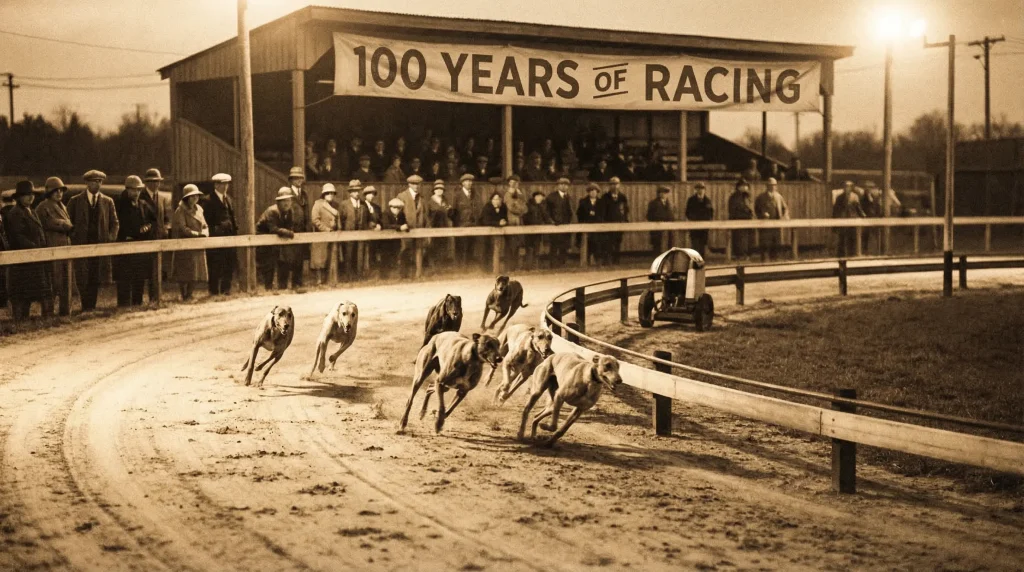
On 24 July 2026, British greyhound racing turns 100. The centenary marks the date in 1926 when the first organised greyhound meeting in the United Kingdom was held at Belle Vue, Manchester — an evening that drew a crowd of thousands and launched a sport that would become, within a decade, one of the most popular spectator activities in Britain.
The greyhound racing centenary 2026 is being treated by the industry not just as a commemoration but as a statement of intent. In a year when the Welsh ban looms and domestic betting turnover continues to decline, the centenary offers a moment to remind the public, the media and politicians that greyhound racing has been part of British sporting life for a century — and that it still draws audiences, generates economic activity, and provides a home for thousands of dogs that are bred to run.
This page traces the sport’s journey from Belle Vue to the modern era and previews the centenary celebration planned for Dunstall Park.
From Belle Vue to the Modern Era: A Century in Highlights
The 1920s and 1930s: Birth and Boom
The Belle Vue meeting on 24 July 1926 was not an accident. Greyhound racing using a mechanical lure had been developed in the United States and imported to Britain by businessmen who saw the potential of a spectator sport that could fill weekday evenings in industrial cities. The early tracks were built near population centres — Manchester, London, Glasgow, Birmingham — and the working-class audiences that flocked to them made greyhound racing the second-biggest spectator sport in the country by the 1930s, behind only football.
The era produced the sport’s first household name. Mick the Miller, an Irish-bred brindle, won the English Greyhound Derby in both 1929 and 1930 — one of only four dogs to win the race twice. He became a genuine celebrity, appearing in a feature film and attracting crowds that rivalled those of top-flight football matches. Mick the Miller’s fame was a product of the times — a working-class hero for a working-class sport — but it set a template for how greyhound racing would market itself for decades to come: through the stories of individual dogs and the drama of the big-race nights.
The Post-War Peak and Long Decline
Greyhound racing reached its peak attendance in the late 1940s, when an estimated 50 million admissions were recorded across British tracks in a single year. The sport was embedded in the fabric of urban life — a night at the dogs was as normal as a night at the cinema, and for many communities it was the primary social event of the week.
The decline began with the arrival of television, which gave people competing entertainment options without leaving their homes, and accelerated through the 1960s and 1970s as urban land became too valuable for greyhound stadiums. White City, the sport’s flagship London venue, was demolished to make way for the BBC Television Centre site — an irony that neatly captures the relationship between the medium that killed greyhound racing’s live audiences and the stadiums that gave way to its infrastructure. Tracks closed at a steady rate through the final decades of the century, and by 2000 the network of licensed venues had contracted from dozens to fewer than 30.
The decline was not uniform. While London lost stadium after stadium — Wimbledon, Wembley, Catford, Hackney, White City — venues in the Midlands and the north proved more resilient, in part because land values were lower and the social role of the track persisted longer. But even in those regions, the trajectory was downward, and the sport entered the 21st century as a fraction of what it had been at its mid-century peak.
The Modern Era
The 21st century brought further contraction but also modernisation. The formation of GBGB as a regulatory body, the introduction of welfare data transparency from 2018, the development of the PGR broadcast model, and the construction of new venues — Towcester in 2014, Dunstall Park in 2026 — represent an industry trying to professionalise in the face of shrinking audiences. The trainer who holds the all-time record for English Greyhound Derby victories is Charlie Lister OBE, with seven wins — a career that spanned the transition from the old world of stadium-based spectating to the new world of television-and-data-driven racing.
The dogs that define the modern era — Westmead Hawk, Ballyregan Bob, and more recently the Irish-trained Derby winners at Towcester — are known primarily through broadcasts and betting markets rather than through turnstile clicks. The sport’s relationship with its audience has changed, but the racing itself — six dogs, a mechanical hare, and 30 seconds of flat-out competition — has not.
The Dunstall Park Anniversary Dinner and 1920s Recreation
GBGB is marking the greyhound racing centenary 2026 with a headline event at Dunstall Park, the Wolverhampton venue that opened in September 2026 as the newest licensed track in Britain. The choice of venue is deliberate: celebrating 100 years at a brand-new stadium ties the sport’s history to its future in a single image.
The centenary dinner is planned as a formal event with a programme that includes a recreation of the original 1926 Belle Vue meeting — six races staged in the style of the 1920s, with period-appropriate presentation and historical commentary. The guest list is expected to include industry figures, leading trainers, owners, media representatives and political figures who have supported the sport. The event is intended to combine nostalgia with a demonstration that greyhound racing remains a living, operational sport rather than a historical curiosity.
The choice of Dunstall Park also highlights the connection between the old and new generations of venues. Dunstall Park made its own piece of history on 7 March 2026, when the venue staged the first combined horse-and-greyhound fixture in British racing history — seven horse races alongside 12 greyhound races on the same day. That dual-code event demonstrated a model that Towcester is also pursuing, and the centenary celebration at the same venue reinforces the idea that greyhound racing’s future lies in innovation and integration rather than isolation.
Whether the centenary generates the kind of public attention that the industry hopes for remains to be seen. A hundred years is a milestone that demands recognition, and GBGB CEO Mark Bird has framed 2026 as a year of celebration in which the sport will remember the greats while demonstrating why it deserves a place in the 21st century. The political context — the Welsh ban, the betting-turnover decline, the ongoing welfare debates — means that the celebration will carry a defensive undertone as well as a celebratory one. But the anniversary is real, the history is rich, and the sport has earned the right to mark the occasion.