Towcester Greyhound Kennels and Training Facilities
 Available in US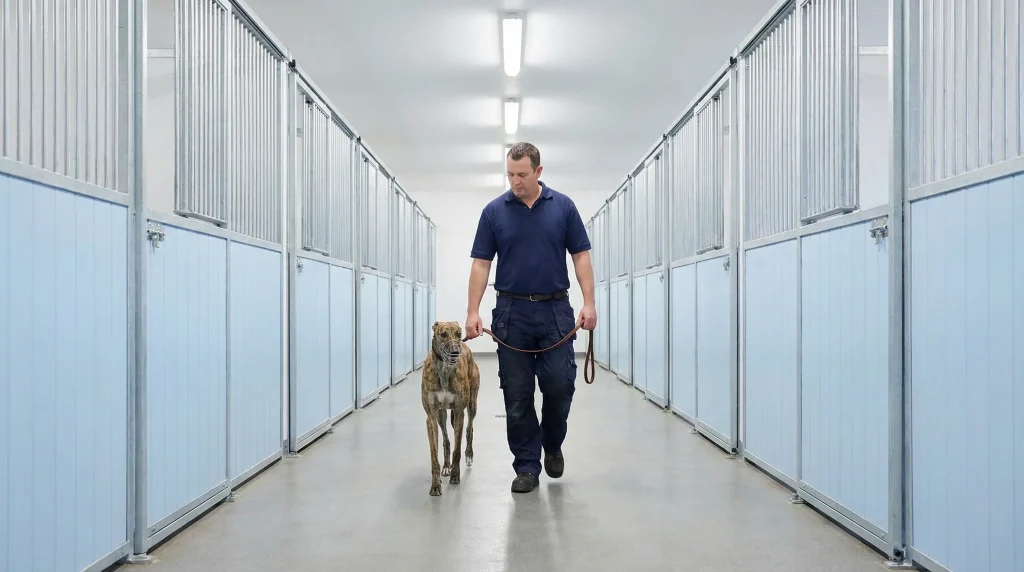
Towcester greyhound kennels operate within the GBGB regulatory framework, which sets minimum standards for housing, welfare and pre-race preparation. But standards vary, and the recent expansion of Towcester’s kennel roster — driven by Orchestrate’s recruitment of trainers from Swindon and Oxford — has brought new facilities and fresh practices to a venue that is evolving quickly. This page explains how the kennel setup works, what trial sessions involve, and how the quality of training infrastructure feeds into the data that punters rely on.
Who runs them is listed in top trainers.
Kennel Setup: Capacity, Layout and Standards
The kennel facilities at a GBGB-licensed track must meet regulatory requirements covering space per dog, ventilation, heating, hygiene and access to veterinary care. At Towcester, the on-site kennels serve the dogs that are racing on any given evening — they provide holding accommodation before and after races, not permanent housing. The dogs live at their trainers’ private kennels, which may be within a few miles of the track or further afield, and are transported to Towcester on race day.
The scale of the operation is significant. Across British greyhound racing, approximately 500 trainers and 6,000 greyhounds are registered at any given time, with around 3,000 kennel hands supporting the daily work of feeding, exercising and preparing the dogs. At Towcester, the expansion to five meetings a week means the venue handles a large throughput of dogs each week — typically 60 or more per meeting, meaning upwards of 300 individual kennel bookings in a full week of racing.
On-Site Facilities
The on-site kennels at Towcester include individual holding bays for each runner, a weighing area where dogs are checked before racing, and veterinary inspection points. The layout is designed for efficiency: dogs arrive, are kennelled, weighed, inspected and moved to the paddock for their race in a sequence that minimises stress and maximises safety. After racing, dogs return to the kennels for a cool-down period and a post-race veterinary check before being collected by their trainers.
The standard of these facilities has improved under Orchestrate’s management. Investment in the track surface and the racing programme has been accompanied by quieter improvements to the kennel block — better ventilation, improved drainage, and attention to the small details that affect how a dog feels when it arrives at the track. A calm, well-managed kennel environment contributes to consistent performance: a dog that is stressed before a race is less likely to break cleanly from the traps or run to its true ability.
Trial Bookings and Schooling at Towcester
Before a greyhound races competitively at Towcester, it typically undergoes one or more trial runs — timed sessions on the actual track, usually held on non-race days, that allow the dog to familiarise itself with the surface, the bends and the hare system. Trials are also used by trainers to assess a dog’s fitness after a break, to test it at a new distance, or to evaluate how it handles the track’s distinctive gradient.
The consistency of the trial surface matters. The 300 tonnes of new sand laid in late 2026 improved not just the racing surface but the trialling surface — a dog that trials on the same material it will race on produces data that is more predictive of race-day performance. When the trial surface differs significantly from the race surface, trial times can mislead: a dog that clocks a fast time on firm sand in a Tuesday morning trial may run slower on a softer, race-worn surface two days later.
Schooling Sessions
Schooling is distinct from trialling. It covers the educational process of teaching a young or inexperienced greyhound how to race — breaking from the traps, following the hare, negotiating bends in the company of other dogs, and running to the finish without being distracted or distressed. Towcester offers schooling sessions for dogs that are new to the track or new to racing altogether, and these sessions are an important part of the pipeline that feeds the kennel roster.
For punters, a dog making its first competitive start at Towcester after a series of schooling sessions is an unknown quantity in terms of race form but not necessarily in terms of ability. Trainers who have watched a dog school well over several sessions will enter it in a graded race with a reasonable expectation of competitiveness. The racecard will show a blank or minimal form line, but the trainer knows more than the card reveals. Spotting dogs with strong schooling backgrounds and capable trainers behind them is one of the quieter edges available to punters who track the towcester greyhound kennels roster closely.
How Kennel and Training Quality Affects Results
The connection between kennel quality and race results is indirect but real. A well-run kennel produces dogs that arrive at the track in good condition — well-fed, well-rested, fit and mentally calm. A poorly run operation produces dogs that are stressed, undertrained or carrying minor issues that do not show up on a racecard but affect performance. The difference is not always visible in a single race, but over a season it shows up in the statistics: kennels with good facilities and attentive staff tend to have higher strike rates and fewer unexplained poor runs than those without.
At Towcester, the influx of experienced trainers from other tracks has raised the average kennel standard. Trainers who operated successful operations at Swindon and Oxford brought their systems, their staff and their dogs to Northamptonshire, and the immediate effect was a deepening of field quality that is visible in the tighter finishing margins and more competitive grading that the venue now produces.
For punters, the practical takeaway is that trainer reputation is a proxy for kennel quality. A trainer with a high strike rate, consistent runners and a record of developing young dogs is almost certainly running a well-organised kennel. Backing dogs from those operations — particularly when they are trying Towcester for the first time after schooling or trialling — is a lower-risk proposition than backing dogs from kennels with erratic records and unexplained form fluctuations.
The wider context is set out in our Towcester greyhound results guide.
