History of Towcester Greyhound Stadium: 2014 to the Orchestrate Era
Best Greyhound Betting Sites – Bet on Greyhounds in 2026
Loading...
Towcester’s greyhound story covers barely a decade — but it packs in a boom, a bust and a rebirth. From an ambitious construction project in 2014 through financial crisis, a change of hands, years of quiet operation, and a dramatic new beginning in late 2026, the towcester greyhound stadium history reads less like a steady corporate timeline and more like a three-act drama.
Understanding that history matters because it shapes the present. The track’s physical characteristics, its relationship with trainers, its place in the PGR schedule — all of these are products of decisions made during earlier eras, and the scars and strengths of those eras are still visible in how the venue operates today. This page follows the chronology from the first shovel in the ground to the current Orchestrate era.
Construction and Opening: December 2014
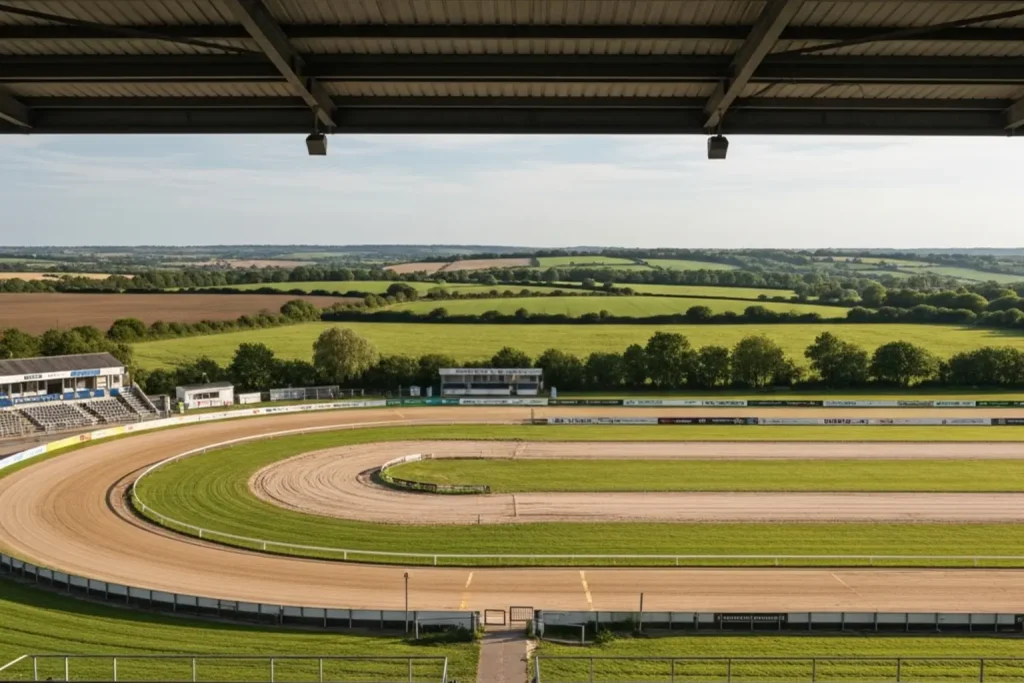
The greyhound track at Towcester was built inside the infield of an existing horse-racing venue, a project that required engineering on a scale unusual for greyhound-stadium construction. According to contemporary records, the build cost £1.5 million and involved moving 60,000 tonnes of earth to bring the greyhound surface level with the main straight of the horse course. That earthwork created the track’s distinctive elevation change — approximately six metres from the back straight to the home straight — which remains Towcester’s most unusual physical feature among GBGB-licensed tracks.
The racecourse at the time was controlled by interests associated with Lord Hesketh, whose family had owned the Towcester estate for generations. The decision to add greyhound racing to the venue was driven by commercial logic: the horse-racing programme alone was not generating sufficient revenue to sustain the site, and greyhound racing — with its lower operational costs and its connection to the bookmaker-funded BAGS model — offered a supplementary income stream.
The track opened on 6 December 2014. Early reactions were positive. The surface was new, the facilities were modern by greyhound-venue standards, and the wider bends — a consequence of the larger-than-typical circumference — were praised by trainers and racing officials for giving dogs more room to race safely. The opening attracted attention partly because new greyhound stadiums were rare: no other purpose-built venue had opened in Britain in recent memory, and Towcester’s arrival added a track to the GBGB network at a time when the overall trend was towards closures rather than openings.
In its early years, Towcester hosted a growing programme that included graded races, open events, and — crucially — the English Greyhound Derby, which moved to the venue in 2017 after Wimbledon Stadium closed. Securing the Derby was a statement of ambition: it positioned Towcester as a flagship venue for the sport’s most prestigious event and brought national attention to a track that was still establishing itself.
The Derby arrival also brought logistical demands. Hosting the competition’s six rounds and the high-profile final required a kennel infrastructure, media facilities and crowd-management capacity that pushed the venue to prove it could operate at a level beyond its regular graded programme. Towcester passed that test, and the Derby became an annual fixture that reinforced the venue’s status as one of the most important tracks in British greyhound racing — a position that would endure even through the turbulent years that followed.
Administration and the Henlow Years
The boom did not last. Towcester Racecourse entered administration in 2018 as the broader financial difficulties of the estate caught up with the racing operation. The administration put the future of both the horse-racing and greyhound programmes in doubt, and for a period it was unclear whether the track would continue operating at all.
The rescue came from Kevin Boothby’s Henlow Racing, which took on the lease and kept greyhound racing alive at the venue. Boothby, who also operated Henlow Greyhound Stadium in Bedfordshire, ran Towcester on a functional but low-investment basis. The track continued to host regular meetings and retained the Derby, but the pace of development slowed. Prize money was modest, the kennel roster was thinner than it had been at peak, and the fixture list settled at three to four meetings a week — enough to fulfil BAGS obligations but short of the venue’s capacity.
The Henlow years were a period of stability rather than growth. The track survived, which was not guaranteed given the financial circumstances, and the racing maintained a baseline quality that kept Towcester on the GBGB calendar. But the ambition that had characterised the opening era — the Derby, the national profile, the talk of Towcester as a destination venue — receded into the background. The racecourse functioned, but it did not thrive. The horse-racing course fell dormant entirely, with no fixtures and limited upkeep, and the greyhound programme operated within the constraints of a promoter whose primary operation was at Henlow rather than Towcester.
For trainers based at the venue during this period, the experience was mixed. The track itself remained a good circuit — the wide bends and the distinctive gradient were still there, and dogs raced safely. But the limited fixture list constrained how many runners a kennel could campaign each week, and the modest prize money made it difficult to attract or retain top-quality training operations. Some kennels relocated to busier tracks; others stayed but entered their dogs at multiple venues to fill the gaps in the Towcester calendar.
Richard Thomas, who would later become CEO under Orchestrate, reflected on the state of the venue when the new management arrived. Speaking to Greyhound News UK, he described Towcester as a really good racecourse and spoke of getting it back to its best — an acknowledgement that the venue had potential that the Henlow years had not fully exploited.
The Orchestrate Takeover and What Changed
On 1 November 2026, Orchestrate took over on a 10-year lease, and the pace of change accelerated immediately. The appointment of Richard Thomas as CEO, the recruitment of trainers from Swindon and Oxford, the 300-tonne surface overhaul, the PGR entry and Sky Sports Racing deal — all happened within the first two months. The towcester greyhound stadium history had never seen a transition this rapid.
The contrast with the Henlow era was deliberate. Orchestrate’s strategy was to invest across multiple fronts simultaneously rather than improving one area at a time. The fixture list expanded to five meetings a week. The prize-money structure was overhauled to attract and retain professional kennels. The broadcast deal gave the track national television coverage for the first time. And the announcement of plans to bring horse racing back to the venue signalled that Orchestrate saw Towcester not just as a greyhound track but as a multi-purpose racecourse with long-term commercial viability.
The new management also focused on the details that previous operators had neglected. Groundstaff appointments brought specialist knowledge of sand-track maintenance. New equipment was purchased for surface preparation. The racing office’s grading processes were reviewed to ensure that the expanded fixture list produced competitive fields rather than thin cards padded with mismatched dogs. These operational improvements were less visible than the headline investments in sand and broadcast deals, but they underpinned the quality of the racing product that audiences and punters now see.
Whether the Orchestrate era delivers on its early promise will be judged over years rather than months. The 10-year lease provides the time horizon for the kind of sustained investment that previous operators lacked. The early signs — fuller fields, a stronger kennel roster, a busier schedule, a visible media presence — are positive, but greyhound racing is a cyclical business subject to economic pressures, regulatory changes and shifting public attitudes. What is clear is that the venue has moved from survival mode to growth mode, and for the first time since its opening, Towcester is being run with the ambition that its infrastructure was built to support.