Towcester Greyhound Trap Stats: Win Rates by Box and Distance
Best Greyhound Betting Sites – Bet on Greyhounds in 2026
Loading...
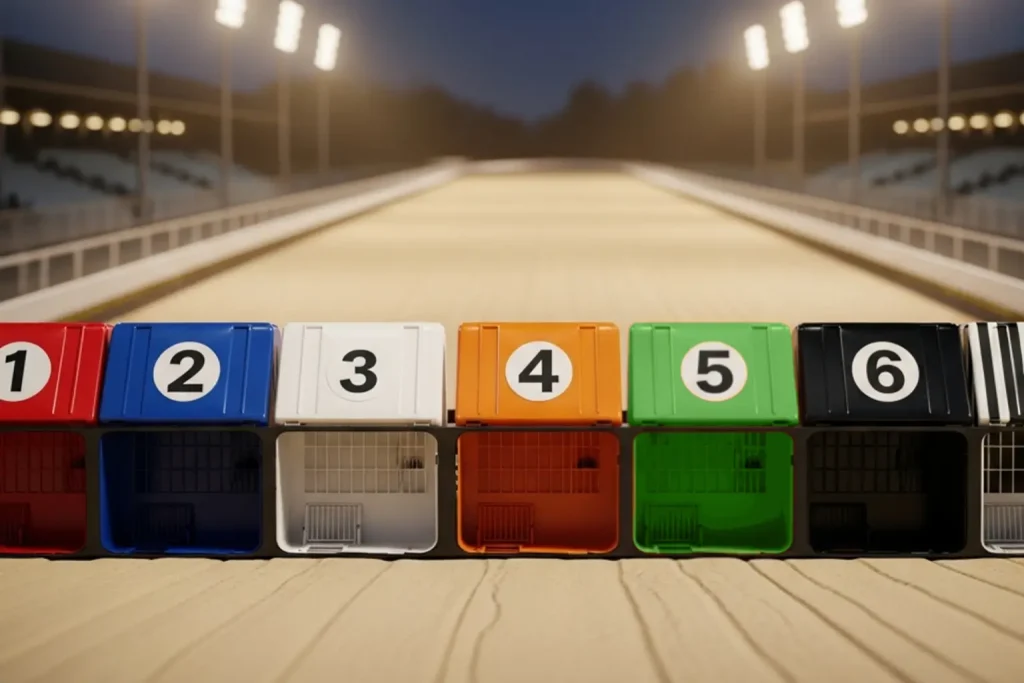
Before a greyhound even leaves the traps, its starting position has already tilted the odds. Trap one hugs the rail. Trap six faces open ground and a long run to the first bend. At Towcester, where the track’s unusual elevation changes and sweeping bends amplify every positional advantage, the box a dog draws can be the difference between a clear run and a crowded exit.
Towcester trap stats deserve particular attention because the track’s geometry is unlike most circuits on the British calendar. The course was carved from an existing horse-racing venue at a cost of £1.5 million, with 60,000 tonnes of earth moved to create a surface that rises roughly six metres from the back straight to the home straight. That gradient is not cosmetic. It affects how dogs handle the bends, where stamina kicks in, and which traps produce front-runners with enough momentum to hold a lead.
This page breaks down Towcester trap stats at both primary distances — the 270-metre sprint and the 480-metre middle-distance trip — then looks at how to fold that data into your race-by-race analysis. The numbers alone do not pick winners, but ignoring them is the quickest way to misread a racecard.
Win Rates by Trap at 270m
The 270-metre sprint is Towcester’s bread-and-butter distance. In 2026, 1,625 of the venue’s 2,911 graded races — 55.8% of the entire programme — were contested over 270 metres. That volume of data gives us a statistically meaningful sample, and the patterns it reveals are consistent enough to matter.
At 270 metres, races involve just two bends. The lids open on a short straight, the field charges into the first turn, negotiates the second, and finishes down the home straight. With only two corners, there is less time for a poorly drawn dog to recover. Early pace and a clean first bend are everything, which is why inside traps historically post stronger win rates at sprint distances on most tracks — and Towcester follows that trend, though with its own quirks.
Trap-by-Trap Breakdown at 270m
Trap one at Towcester’s 270 metres tends to produce the highest win percentage across large sample sizes. The rail advantage is tangible: a dog in box one has the shortest distance to cover into the first bend, and at sprint pace there is almost no time for rivals to cross and challenge. The typical win rate for trap one at 270 metres hovers in the region of 20–22%, well above the 16.7% you would expect if all six traps were equal.
Trap two benefits from a similar positional effect but slightly less rail protection. It often returns the second-highest strike rate at this distance. The middle traps — three and four — tend to cluster near the mathematical average, sometimes dipping just below. Trap five has variable fortunes depending on the grading of the race, while trap six, out wide, consistently posts the lowest win percentage at 270 metres. Wide runners need exceptional early pace to cut across the field, and at two bends the margin for error is razor-thin.
What the Sprint Bias Means in Practice
A punter studying Towcester trap stats at 270 metres should treat the inside-trap advantage as a baseline expectation, not a rule. Seeding plays a role: racing managers place faster dogs in wider traps to balance fields, so a trap-six runner in a sprint may genuinely be the quickest dog in the race. The bias is real, but it competes with grading adjustments, recent form, and the dog’s individual running style. A confirmed wide runner with sharp early pace can overcome the rail disadvantage — it just does so less often than the raw percentages suggest.
Where the bias becomes most actionable is in lower-grade sprints. In A5 through A8 races, where the field is less separated by ability, the trap draw exerts more influence on the outcome. In open-class sprints, talent tends to override geometry.
Win Rates by Trap at 480m
Switch to 480 metres and the trap-bias picture shifts. Four bends mean more racing, more crowding at the turns, and more opportunities for a dog to work into position regardless of where it started. The inside-trap advantage does not vanish, but it softens considerably — and certain outside boxes gain ground they never had at the sprint distance.
How Four Bends Redistribute Advantage
At 480 metres, trap one still benefits from rail position into the opening bend. But because there are two additional turns, a dog that breaks level from trap three or four often finds racing room on the second and third bends that was never available in a two-bend sprint. The win-rate spread across traps at 480 metres narrows compared to 270 metres. You are more likely to see traps three and four competing with traps one and two for the top strike rate, while traps five and six remain below average but not as far adrift as in sprints.
The reason is partly physical: Towcester’s bends are wide by British standards, built to accommodate greyhounds running at pace on a surface that rises and falls. That width allows mid-pack runners to swing wide without losing as much ground as they would on a tighter circuit. A dog drawn in trap five with a strong mid-race pace can use the second bend to move up, then hold position through the final two turns.
Stayers and the Trap Draw
On the occasions Towcester cards longer trips — hurdle events or stayer races — the trap draw matters even less in absolute terms but more in how it shapes the early running. A front-runner from trap one in a stayer race can set a pace that suits it through multiple bends; a closer from trap six may be content to settle and pick off tiring dogs in the home straight. The strategic dimension of the 480-metre trip makes trap stats one factor among several rather than the dominant variable they can be at 270 metres.
The practical takeaway: if you are analysing a 480-metre card and two dogs look evenly matched on form, the one in the lower trap has a marginal edge — but it is genuinely marginal, not the kind of advantage that should override a clear form line.
How to Factor Trap Stats Into Selections
Trap stats are a filter, not a verdict. The most productive way to use them at Towcester is to layer the data on top of your existing form analysis, not to replace it. Start with the basics — recent finishing positions, sectional times, trainer form — then check the trap draw as a tiebreaker or a confidence booster.
The first question is always distance. If the race is a 270-metre sprint, give the trap draw more weight. If it is 480 metres, treat it as a secondary consideration. The second question is grade: lower-grade races amplify trap bias because the dogs are more closely matched and less capable of overcoming a bad draw through sheer speed. Open-class events are more likely to be decided by talent.
Surface conditions add another layer. After Orchestrate’s arrival in late 2026, the track received roughly 300 tonnes of fresh sand as part of a comprehensive surface overhaul. Changes to the running surface can temporarily reset bias patterns. A trap that performed strongly on the old surface may behave differently until the new sand beds in and a fresh sample of results builds up. Any punter working with historical Towcester trap stats should treat data from before the surface upgrade with mild caution — it is still relevant, but the baseline may have shifted.
Finally, keep sample size in mind. A trap’s win rate calculated from 50 races is less reliable than one drawn from 500. Towcester’s busy schedule — five meetings a week under the PGR banner — generates data quickly, but it is still worth checking how recent the numbers you are using actually are. Trap stats are most useful when they are fresh, drawn from the current surface and the current grading patterns. Treat them as a living dataset, not a fixed table, and they will serve you well.