
Towcester Greyhound Track Layout, Surface and Trap Bias
Best Greyhound Betting Sites – Bet on Greyhounds in 2026
Loading...
The Track Itself Is a Variable in Every Towcester Result
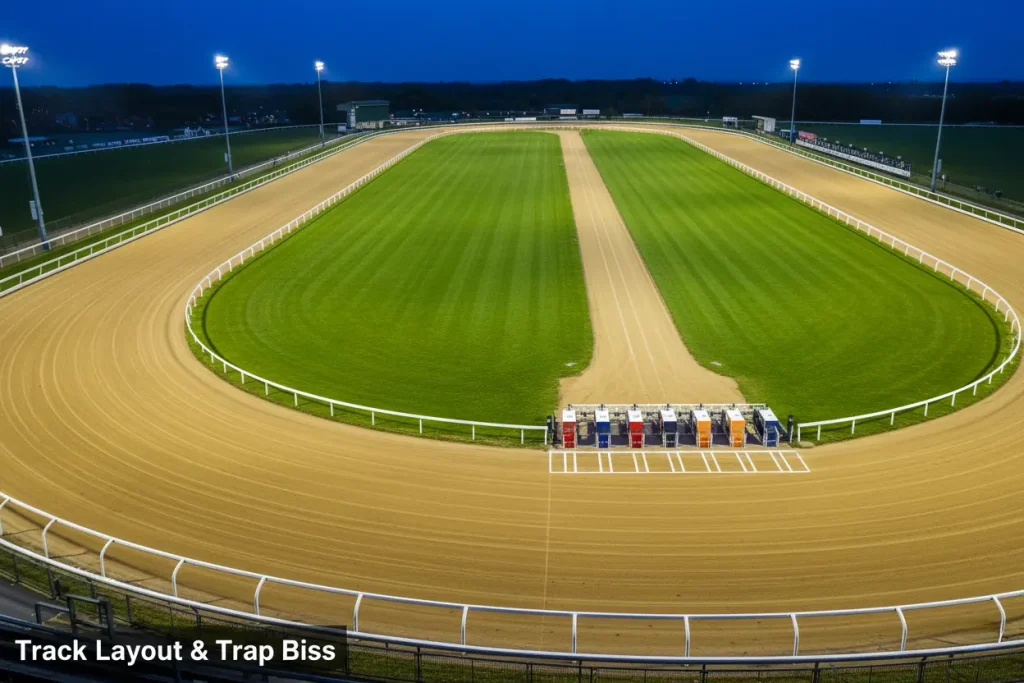
Most punters study the dogs. Fewer study the track. That is a mistake at any venue, but at Towcester it is a particularly costly one. This is not a standard greyhound circuit. The track was carved into the landscape of an existing horse-racing venue at a cost of £1.5 million, with 60,000 tonnes of earth moved to raise the greyhound surface level with the main horse-racing straight — creating a six-metre elevation change across the site. That topography influences how every race unfolds, from the speed dogs carry into the bends to the stamina demanded on the straights.
Towcester greyhound trap bias is not an abstract concept here. It is a measurable, trackable factor that shifts with distance, surface condition, and weather. A runner drawn in trap one over 270 metres faces a fundamentally different race from one drawn in trap six over 480 metres, and the track’s geometry is the reason. Since Towcester joined the Premier Greyhound Racing schedule in November 2026, the increased volume of racing — five meetings a week, up from three or four — has generated a richer dataset for bias analysis than the track has ever produced. Understanding that geometry and its interaction with the six-box starting configuration is the foundation of any serious results analysis at this venue.
This guide takes the track apart piece by piece: dimensions, surface, trap statistics, weather effects, and the maintenance regime that keeps the whole thing running. If you treat Towcester results as pure form data without accounting for the track underneath, you are reading half the story.
Track Dimensions: Circumference, Bends and Straights
Towcester’s greyhound circuit has a circumference of approximately 420 metres, making it a mid-sized track by GBGB standards. For context, Romford runs around 370 metres and Nottingham at roughly 430. The circumference matters because it determines bend tightness: a smaller circumference means sharper bends, which favour agile, rail-hugging dogs. A larger one produces wider, more sweeping turns that allow bigger-striding runners to maintain speed. Towcester sits in the middle, offering bends that are neither punishingly tight nor expansively wide.
The bends at Towcester are banked, which helps greyhounds maintain speed through the turns rather than decelerating as they would on a flat curve. Banking is standard across modern GBGB tracks, but the degree varies, and it interacts with the surface composition to determine how much grip the dogs can generate mid-turn. On a well-maintained surface with adequate banking, a greyhound loses perhaps 0.1 to 0.15 seconds per bend compared to straight-line speed. On a surface that has dried out or shifted, that loss increases — and it compounds over four bends in a 480-metre race.
The back straight and home straight differ in length, and that asymmetry has tactical consequences. The home straight at Towcester is long enough to allow overtaking — a feature that not every track offers. At venues with a short run-in, a dog that leads off the final bend is almost impossible to catch. At Towcester, a strong finisher has a realistic window to close down a tiring leader, particularly over the sprint distance where the home straight constitutes a larger proportion of the total race. This is one reason why Towcester occasionally produces sprint results where a closer beats a front-runner — the home straight gives them the room to do it.
The construction of the track is what makes Towcester genuinely unusual. The £1.5 million project in 2014 required not just laying a surface but engineering an entire landform. The 60,000 tonnes of earth created a plateau that raises the greyhound track to meet the elevation of the existing horse-racing course. That six-metre rise is not concentrated at one point — it is distributed across the circuit, which means certain sections run slightly uphill and others slightly downhill. Dogs running the back straight may be gaining a few inches of elevation without the viewer noticing, and that gradient drains stamina in ways that a flat-track time comparison does not capture.
For anyone comparing Towcester times with those from flat venues like Romford, this topography is the hidden variable. A dog that runs 29.8 seconds over 480 metres at Towcester is not necessarily slower than one clocking 29.5 at a flat track. It may be running the same level of performance against a harder course. Until you account for the elevation profile, cross-track time comparisons involving Towcester are unreliable at best.
Surface Composition and the 2026 Sand Upgrade
Every greyhound track in Britain runs on sand, but the type, depth, and condition of that sand vary enormously — and those variations directly affect race times, injury rates, and the reliability of form data. Towcester’s surface has undergone a significant transformation since Orchestrate took over the venue in November 2026.
The headline investment was the addition of approximately 300 tonnes of new sand to the running surface. That is not a top-up. It is a comprehensive resurfacing designed to replace material that had degraded, compacted, or lost its drainage properties over time. Sand on a greyhound track endures enormous stress: six dogs at full speed generate significant downward force, particularly on the bends, and the surface must absorb that impact while providing consistent grip and cushioning. Over months of racing, the sand breaks down, compacts unevenly, and becomes less effective at draining water. The 300-tonne upgrade addressed all of these issues.
James Chalkley, Towcester’s Head of Racing, described the approach in uncompromising terms. “We have not been afraid to go right back to the basics with the surface,” he told the Racing Post. “The extra sand and revised maintenance regimes are about delivering a track that is as safe as possible for the greyhounds to run on, from the first race to the last, all-year round.” That last detail is significant: consistency across an entire meeting card, and across seasons, is the goal. A track that rides fast for the first four races and then deteriorates by race ten is dangerous for dogs and useless for form analysts.
The composition of the new sand matters as much as its volume. Greyhound track sand is selected for specific grain size, angularity, and drainage characteristics. Finer sand packs tighter and produces a faster, firmer surface. Coarser sand is more forgiving and drains better but can slow times. The exact specification used at Towcester has not been publicly detailed, but the Racing Post report notes that the changes were made in consultation with specialist track maintenance staff — Josh and Derren Sealey — brought in specifically for the project.
For form analysts, the surface change creates a before-and-after divide in the data. Times recorded before the resurfacing and times recorded after are not directly comparable. A dog that ran 15.75 seconds over 270 metres on the old surface and now runs 15.85 on the new one has not necessarily slowed down — the surface may simply be offering more cushioning and less pace. Conversely, some dogs that struggled on the old surface may find the new composition suits their foot type and stride pattern. The first two to three months of results on a new surface are calibration data. Treat them as such.
Drainage is the unsung hero of surface management. A track that drains well recovers quickly from rain and maintains consistent going throughout a meeting. A track with poor drainage develops boggy patches, usually on the inside rail where water accumulates, and those patches slow dogs unpredictably. Towcester’s elevated construction actually helps here — the gradient means water runs off the higher sections naturally — but it also creates the risk of pooling in lower areas. The new sand and revised maintenance protocols are designed to manage this, but weather will always be a variable at an outdoor venue in Northamptonshire.
Trap Bias at Towcester: What the Numbers Show
Towcester greyhound trap bias follows a pattern that is common across British greyhound tracks but has its own local characteristics shaped by the circuit’s geometry and distances. The fundamental principle is simple: inside traps have a shorter run to the first bend, which gives the dog drawn there a positional advantage. The practical reality is more nuanced.
Over the 270-metre sprint — which accounts for 55.8 per cent of all graded races at the track — the trap-one advantage is at its most pronounced. The run from the boxes to the first bend is short, and a dog that reaches the apex of the turn on the rail has the most efficient racing line for the remainder of the race. Trap-one win rates over the sprint tend to sit above the 16.7 per cent baseline (which would represent an equal share among six traps), often in the range of 20 to 25 per cent depending on the sample period. Trap six, the widest draw, typically records win rates below the baseline because the dog must cover extra ground to find a position, and over two bends there is limited opportunity to recover.
At 480 metres, the picture changes. The run to the first bend is longer, which gives all six dogs more time to find their positions before the first turn. The additional two bends also provide more opportunities for the race to restructure — a dog drawn wide that breaks well can find a position on the second or third bend that it would never reach in a sprint. Consequently, the trap-one advantage at 480 metres is smaller than at 270, and the outside-trap disadvantage is less severe. Win rates across the six traps are more evenly distributed over the longer distance, though trap one typically retains a modest edge.
Trap three tends to be an interesting case at Towcester. In many samples, it produces above-average win rates across both distances. The theory is that trap three offers the best of both worlds: close enough to the rail to benefit from a short run to the bend, but far enough from the inside that the dog avoids the crowding that sometimes traps one and two runners in a pocket. A dog with moderate early pace drawn in trap three has a natural racing line into the first turn that does not require it to be the fastest breaker in the field. This is especially relevant in lower-graded races where trap speed varies more widely and the first bend is less predictable.
Seasonal variation affects trap bias in ways that are often underappreciated. In wet conditions, the inside rail can become the heaviest part of the track because water drains towards the lowest point of the banked bends. A trap-one runner that hugs the rail in a downpour may be running on the slowest strip of sand on the circuit. In dry, firm conditions, the same rail position is the fastest line. This seasonal flip means that trap-bias models built on summer data can mislead in winter, and vice versa. Any serious trap-bias analysis at Towcester should segment the data by season — or, at minimum, by surface condition report.
A further complication is the interaction between trap draw and grading. In higher-graded races, dogs are seeded into traps based on their running style — inside runners go to inside traps, wide runners go to outside traps. This seeding dilutes the raw trap bias in the data, because the dogs drawn inside are the ones most likely to benefit from an inside draw. In lower-graded races, seeding is less precise, and the raw trap-draw advantage is more influential. If you are using trap-bias statistics, check whether the sample includes all grades or is filtered by grade band. The numbers can tell different stories depending on how the data is sliced.
How Weather Shifts Race Times
Towcester is an outdoor facility in the East Midlands, which means it is exposed to the full range of British weather: rain, frost, heat, wind, and everything in between. Each condition affects the track surface differently, and through the surface, the race times.
Rain is the most frequent disruptor. A sustained downpour loosens the top layer of sand, reducing compaction and creating a heavier going. Dogs run slower on wet sand — the added weight underfoot demands more effort per stride. Over a 270-metre sprint, a heavy surface might add 0.1 to 0.2 seconds to the winning time. Over 480 metres, the cumulative effect is larger: half a second or more is not unusual after persistent rain. Lighter-framed dogs tend to cope better with soft going because they sink less into the surface. Heavier, more powerful dogs that rely on a firm footing to generate speed can struggle disproportionately.
Frost produces the opposite effect. A frozen surface is firm and fast, and dogs can clock quick times on a frosty morning card. But frost also reduces the sand’s shock-absorption properties, which increases the stress on joints and tendons. Track management teams monitor frost levels closely, and meetings can be abandoned if the surface is judged too hard for safe racing. When a meeting does go ahead on a frosty surface, expect faster times but also more cautious assessments — a fast time recorded on an unusually firm surface does not necessarily translate to the same performance on a standard going.
Heat and prolonged dry spells bake the surface, which can create a crust on the top layer while the sand underneath remains loose. This is an inconsistent going — the dogs break through the crust in some strides but not others, which makes for unpredictable times and increased injury risk. Track teams manage this by watering the surface, but the timing and volume of watering can vary from meeting to meeting. A card that starts on a watered surface may dry out as the evening progresses, meaning later races run on a different going from earlier ones. If you are analysing a full meeting’s results and notice times drifting faster through the card, heat-induced surface change is the likely explanation.
Wind is the most underrated weather factor. Greyhounds racing into a headwind on the home straight lose time. Those with the wind behind them on the back straight gain it. In extreme cases, a strong crosswind can push dogs off their racing line on the bends, disadvantaging inside runners who get pushed wide. Wind data is not routinely recorded alongside race results, which makes it a hidden variable — but on exposed sites like Towcester, where the surrounding countryside offers limited shelter, it can influence times by a measurable margin.
Track Maintenance Under Orchestrate
A greyhound track is not a static surface. It is an engineered environment that requires constant management to remain safe, consistent, and fair. Under Orchestrate’s ownership, Towcester’s maintenance regime has been overhauled — and the personnel behind the overhaul are a deliberate part of the story.
James Chalkley singled out the recruitment of Josh and Derren Sealey as a pivotal change. “Bringing Josh and Derren gives us a wealth of specialist knowledge on how to get the very best out of Towcester’s circuit and overcome the challenges we ultimately face,” he told the Racing Post. “Their experience is already making a visible difference to how the track is prepared and presented for every meeting.” The phrasing is telling: this is not a general improvement claim, it is an acknowledgment that track preparation is a specialist craft and that Towcester’s previous regime was not delivering the standard the new management wanted.
Day-to-day maintenance at a greyhound track involves harrowing the surface between races to redistribute sand and prevent compaction in high-wear areas — typically the bends and the first 50 metres out of the boxes, where six dogs at full speed churn the surface simultaneously. The depth of harrowing, the pattern, and the timing all affect the going for the next race. A deep harrow loosens the surface and slows times. A light pass smooths the top without changing the compaction underneath. The maintenance team makes these judgments on the fly, responding to the condition they observe after each race.
Between meetings, the work is more substantial. The surface is graded to restore a uniform profile across the entire circuit, drainage channels are cleared, and any damaged sections — usually on the bends where centrifugal force pushes sand outward — are rebuilt. After heavy rain, the team may need to add sand to low-lying areas where material has been washed away. In winter, frost protocols dictate whether the track is fit for racing: surface temperature readings are taken at multiple points, and if any section falls below the threshold, the meeting is called off.
The 300-tonne sand upgrade was the most visible investment, but the revised maintenance schedules are arguably more important for long-term consistency. A new surface degrades over time if the maintenance does not match the usage. With five meetings a week under the PGR schedule — up from three or four under the previous operator — the track sees substantially more traffic, which means more wear and faster degradation if maintenance does not keep pace. Orchestrate’s response has been to increase both the frequency and the specialism of the maintenance work, treating track preparation as a competitive advantage rather than a background cost.
For punters, all of this matters because it affects the predictability of form. A well-maintained track produces consistent going from meeting to meeting, which means times are comparable and form can be trusted. A poorly maintained track produces erratic going, which introduces noise into the data and makes form analysis less reliable. The fact that Orchestrate has invested in both surface and staff is, indirectly, an investment in the quality of the results data that Towcester generates.
Using Bias Data in Betting Decisions
Knowing that Towcester greyhound trap bias exists is one thing. Incorporating it into betting decisions without oversimplifying is another. The temptation is to reduce the data to a rule of thumb — “always back trap one in sprints” — and apply it mechanically. That approach will lose money. The bias is real, but it is one factor among many, and its influence varies with conditions, grade, and the specific dogs in the race.
Start by checking the current bias data rather than relying on historical averages. Trap-bias patterns shift when the surface changes — and the surface at Towcester has changed significantly with the 300-tonne sand upgrade. Data from 2026 may not reflect the bias profile of 2026. If you are using a statistics service, filter for the most recent three to six months of results. That window is long enough to produce a meaningful sample but recent enough to capture the current surface and maintenance regime.
Next, weight the bias by distance. Over 270 metres, a favourable trap draw is worth more than over 480 metres. If you are assessing a sprint and two dogs look similar on form, the one with the better draw should get the edge — all else being equal. Over 480 metres, the draw is less decisive, and other factors such as stamina, bend-running ability, and closing speed should take priority. The mistake is applying the same trap-draw weighting to both distances. It is not a uniform advantage.
Factor in the conditions on the day. If it has rained heavily and the inside rail is likely to be heavy, the trap-one advantage diminishes. If the surface is dry and firm, the inside rail is the fastest line on the track and the advantage increases. You will not always have condition data before placing a bet, but if you are watching the early races on a card and noticing that inside runners are labouring, that is live information you can use for the later races.
Consider the seeding. In higher-graded races, the racing manager seeds dogs into traps based on their running style. A natural railer will be drawn inside; a wide runner will be drawn outside. This seeding means that the trap-one advantage in high-grade races is partly built into the allocation — the dog drawn there is already the one most likely to use the rail. In lower-graded races, seeding is less precise, and the draw is more random. The raw trap advantage is therefore more valuable in lower grades, where a genuine railer might find itself drawn in trap four and a moderate breaker might luck into trap one.
The most profitable application of Towcester greyhound trap bias data is not as a standalone betting angle but as a tiebreaker. When two or three dogs in a race look competitive on form, sectionals, and trainer profile, the trap draw can be the factor that separates them. Used this way — as a marginal edge applied to otherwise close decisions — trap-bias data adds value without demanding more precision than the data can deliver. The numbers tell you where the advantage lies. Your job is to decide how much that advantage is worth in the context of each individual race.